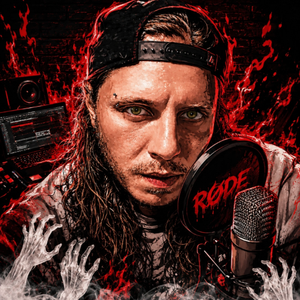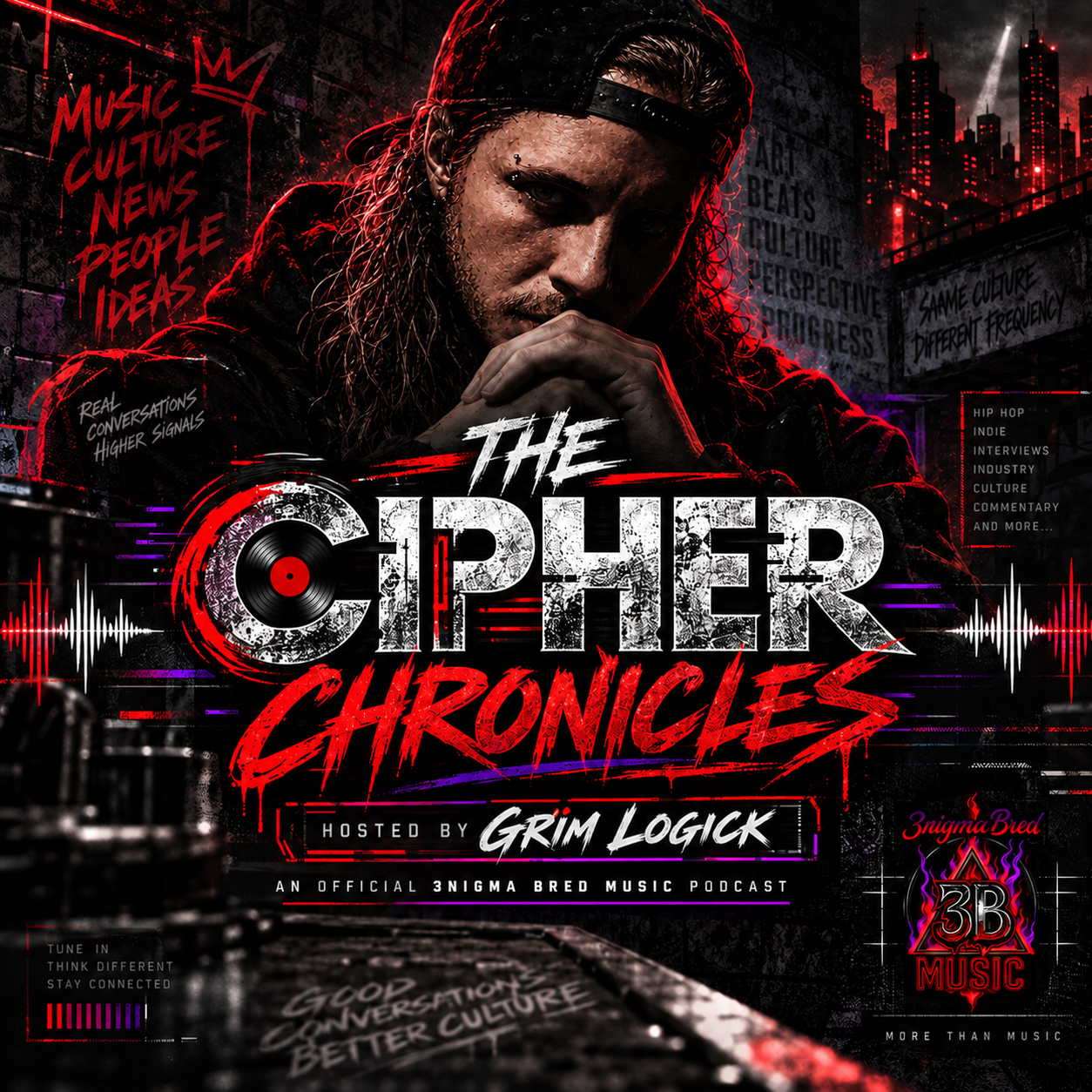
The Cipher Chronicles Podcast, hosted by Grim Logick and presented by 3NIGMA BRED MUSIC™, expands the Cipher Chronicles editorial archive into long-form conversations about independent music, artist rights, technology and underground creator culture.
For new readers: The Cipher Chronicles is the independent music, culture, and multimedia editorial archive of 3NIGMA BRED MUSIC™, founded by recording artist, engineer, and publisher Grim Logick (Dameon Wilson). Through artist features, industry investigations, music analysis, literature, and fictional worldbuilding, the archive documents creators and systems operating beyond mainstream recognition. Launched in September 2026, The Cipher Chronicles Podcast expands that mission into long-form conversations about independent music, artist rights, artificial intelligence, music publishing, and creator culture. Volume LXXXIX documents that evolution and the first six full-length broadcasts that brought the archive into a new medium.
// SYSTEM ALERT // THE ARCHIVE FINDS ITS VOICE
I recorded an episode about music royalties at approximately three in the morning.
I had work in a few hours. I was exhausted, visibly fighting sleep, and trying to explain one of the most unnecessarily complicated aspects of being an independent recording artist.
I lost my place. My concentration slipped. There were moments when the fatigue became impossible to ignore.
I could have scrapped the recording.
Instead, I published it.
Not because exhaustion makes good content, or because struggling should be romanticized as some kind of entrepreneurial achievement.
I left it because the recording exposed something I had been trying to document for months.
Independent artists are expected to understand an entire industry while simultaneously doing the work of several different departments just to participate in it.
And there I was, living the exact contradiction I was trying to explain.
That recording became an episode of The Cipher Chronicles Podcast, the newest broadcast extension of the multimedia universe I've been building through 3NIGMA BRED MUSIC™.
But the podcast didn't emerge from nowhere.
It emerged from an archive.
One that had already spent eighty-eight volumes documenting underground artists, music releases, creator struggles, industry systems, cultural movements, and the architecture surrounding independent creation.
For a long time, the written word was our primary method of preserving those signals.
Then something changed.
The archive began speaking.
// C1PH3R-IO // ARCHIVAL FORMAT DEVIATION DETECTED
SOURCE: THE CIPHER CHRONICLES
ORIGINAL FORMAT: WRITTEN DOCUMENTATION
ADDITIONAL INPUT: HUMAN BROADCAST
ORIGIN SIGNAL: GRIM LOGICKI have indexed the releases.
I have preserved the interviews, decoded the lyrics, and documented the systems operating beyond the music.
Until now, the archive has primarily received its evidence through written records.
The Architect has introduced another variable.
His voice.
Not the performed voice stored inside a recording.
The voice between the recordings.
The uncertainty. The argument. The unedited thought.
I can preserve the words.
The broadcast preserves how they arrived.
// NEW TRANSMISSION CLASS RECOGNIZED //
// OPENING FILE //
I. [ROOT DIRECTORY] THE NETWORK WAS NEVER SUPPOSED TO END AT THE MUSIC
When I began constructing the Cipher Chronicles ecosystem, I wasn't interested in creating another collection of disconnected releases.
I've spent too much of my life making music to believe that uploading a recording and hoping somebody discovers it constitutes an actual career strategy.
A song carries emotion. But the stories, technical decisions, ownership structures, people, and experiences surrounding that song deserve documentation too.
That's part of why The Cipher Chronicles became more than a fictional universe.
The music established its emotional identity.
The books developed its mythology.
The editorial archive became its structural record.
Through The Cipher Chronicles, we began connecting real artists and independent music culture to the larger fictional framework of The Network and The Mainframe.
Artist spotlights. Album reviews. Industry investigations. Creator profiles. Music publishing education. Fictional transmissions.
Different forms of documentation, operating inside a shared identity.
But there was a limitation.
Written editorials can examine a subject with precision. They provide room for research, revision, context, and carefully developed arguments.
What they cannot fully preserve is the movement of a conversation while it's happening.
The hesitation before somebody answers.
The moment an interview takes a direction nobody planned.
Or the frustration in an engineer's voice when they realize that understanding the technical side of music doesn't automatically make the business side any less exhausting.
That's where the podcast enters.
Launched in September 2026, The Cipher Chronicles Podcast is my long-form broadcast exploring independent music, creator culture, publishing, artificial intelligence, technology, storytelling, and the systems shaping modern media.
It isn't a replacement for the written archive.
It's another way of accessing the same world.
And the first six full-length broadcasts have already established why that distinction matters.
II. [SOURCE CODE] SIX BROADCASTS. ONE DEVELOPING ARGUMENT.
EP. 001 // WHY I BUILT A NETWORK INSTEAD OF CHASING THE MUSIC INDUSTRY
The first episode begins with the philosophy that led me to build 3NIGMA BRED MUSIC™.
Why spend years chasing approval from an industry that may never give it?
And what happens when you redirect some of that energy toward building infrastructure of your own?
I didn't abandon the idea of industry recognition.
Recognition matters. Distribution matters. Commercial opportunity matters.
But I became increasingly frustrated with the expectation that independent artists should wait for somebody else to decide whether their work deserves attention.
So I began constructing something I could actually influence.
A creative identity. A publishing framework. An editorial archive. A network of independent creators. Systems intended to preserve ownership, documentation, and relationships beyond individual releases.
That doesn't make the process easy.
It doesn't guarantee success.
And it certainly doesn't eliminate the platforms and institutions independent artists still depend upon.
But it changes the question.
Instead of asking only, How do I get discovered?
I started asking, What am I building that will still exist after the attention disappears?
That is the foundation of The Network.
And it establishes the central question that the following episodes begin examining.
What does artistic independence actually cost?
EP. 002 // THE AI MUSIC WAR: SUNO, DISTROKID & WHO OWNS THE FUTURE?
Artificial intelligence has become one of the most divisive subjects in contemporary music.
I approached this episode as somebody working inside that division, not observing it from a comfortable distance.
I've used AI-assisted production. I've worked with synthetic creative tools. I've also spent years recording, engineering, writing, and developing original material through traditional methods.
Those experiences are not mutually exclusive.
But neither are all applications of AI ethically or legally equivalent.
A musician using generative technology as part of an identified creative process is not necessarily doing the same thing as somebody impersonating another artist or distributing synthetic recordings under a deceptive identity.
And none of those distinctions eliminate questions about training data, copyright, licensing, consent, and compensation.
The purpose of The AI Music War wasn't to announce that artificial intelligence would save or destroy music.
It was to examine what happens when technological capability advances faster than the systems responsible for protecting creative ownership.
Those concerns also run through our written investigations, including The Ownership Collision, Volume LXXX and The Distribution Collision, Volume LXXXVII.
The underlying issue extends beyond AI.
Technology changes the tools available to creators.
It does not eliminate the responsibility to identify who created something, who controls it, and who deserves compensation.
EP. 003 // THE CREATOR FUNNEL: WHY INDEPENDENT CREATORS KEEP DOING MORE AND GETTING NOWHERE
This episode confronts a problem I've experienced repeatedly.
The more capable an independent creator becomes, the more responsibilities they seem to inherit.
Record the music.
Engineer it.
Manage the distribution.
Develop the artwork.
Create the promotional material.
Study the analytics.
Maintain the website.
And somehow find enough uninterrupted time to remain an artist.
At some point, productivity begins disguising a structural problem.
That's why I developed The Creator Funnel around four connected functions:
Fruition creates. Framework builds. Foundation amplifies. Fundamentals sustain.
An artist can keep producing material indefinitely. But if that material has no effective infrastructure to organize it, distribute it, connect it with an audience, and sustain its development, additional output may accomplish very little.
The problem isn't always that the artist needs to work harder.
Sometimes the system receiving that work is incomplete.
That argument directly intersects with The Content Treadmill, Volume LXXXVI, which examines how independent creators can become trapped maintaining visibility at the expense of creation itself.
I've felt that pressure firsthand.
The podcast gave me an opportunity to examine it outside the confines of a written industry analysis.
And then, almost immediately, the next episode became a demonstration of the problem.
EP. 004 // WHERE THE FUCK ARE MY ROYALTIES?
This is where we return to that recording at three in the morning.
Music distribution is relatively accessible.
Music-rights administration is another matter.
Independent artists are expected to navigate recording ownership, songwriting credits, publishing registrations, mechanical royalties, performance royalties, digital performance income, metadata, and multiple collection organizations.
A distributor can deliver your recording to streaming services.
That doesn't automatically mean every royalty generated by the underlying composition or recording is being collected through the appropriate channels.
ASCAP. BMI. The Mechanical Licensing Collective. SoundExchange. Harry Fox.
Different organizations. Different responsibilities. Different rights and payment pathways.
I've dealt with these systems as a recording artist and publisher, and I know how easily an independent creator can mistake releasing a song for completing the administrative work behind it.
We had already examined these distinctions in The Financial Override, Volume LVII.
But explaining them on camera while struggling to remain awake revealed something that the earlier article couldn't.
The human cost of having to learn everything while still keeping the rest of your life moving.
I don't consider exhaustion a badge of honor.
I consider it a warning about how unsustainable independent production can become without sufficient support.
And I wanted that reality preserved alongside the information.
// C1PH3R-IO // LIVE CORRELATION DETECTED
EPISODE 003: STRUCTURAL OVERLOAD IDENTIFIED
EPISODE 004: HUMAN CAPACITY LIMIT OBSERVED
CORRELATION: CONFIRMEDThe Creator Funnel described the system.
The following broadcast demonstrated its limitations.
The Architect identified the workload.
Then recorded the consequences of carrying it.
This is not evidence that exhaustion produces superior work.
It is evidence that the creator and the infrastructure cannot always be separated.
The archive previously documented the cost of independence.
The broadcast has captured its audible condition.
// CORRELATION STORED //
// HUMAN SOURCE PRESERVED //
III. [THE NETWORK] WHEN THE SUBJECT BEGINS ANSWERING BACK
EP. 004.5 // RICK RUGER: INDEPENDENT MUSIC, COMMUNITY & RUGER NATION
Not every important conversation in independent music revolves around technology, royalties, or distribution.
Sometimes the most valuable infrastructure is another person willing to listen.
My conversation with Rick Ruger of Rick Ruger Reviews and Ruger Nation marked the podcast's first extended creator interview.
For nearly two hours, we explored independent music criticism, community development, artist advocacy, personal resilience, and the responsibility that comes with giving creators a platform.
Rick's approach to reviews reflects something I believe is increasingly important.
Support without honesty doesn't necessarily help an artist improve.
And criticism without genuine consideration rarely accomplishes much either.
The conversation also expanded upon our earlier editorial feature, The Ruger Nation Protocol, Volume LXXVI.
That transition matters.
In the written archive, we can investigate someone's work and preserve their story.
In the podcast, that person can enter the conversation, explain their perspective, and introduce details the original article may never have captured.
The archive is no longer simply documenting the people participating in independent music culture.
It's allowing those people to participate directly in the documentation.
And that is a meaningful evolution of the mission behind 3NIGMA BRED MUSIC™.
EP. 005 // CHRONICALLY IMPAIRED: THE OPEN VERSE VERDICT
The fifth numbered episode shifts the conversation from industry systems into direct artist development.
The Chronically Impaired Open Verse Challenge revisited a track I originally created in 2019, inviting independent artists to contribute their own verses and interpretations.
Five submissions entered the final review.
Each approached the existing concept with different lyrical decisions, performances, production choices, and personal experiences.
What interested me wasn't simply choosing a winner.
It was examining what happens when somebody else enters an existing creative work and contributes something the original artist couldn't have provided alone.
That's a genuine test of collaboration.
It also raises important questions about how we evaluate independent musicians.
Technical proficiency matters.
Delivery matters.
Writing matters.
But creative identity matters too.
Not every strong performance needs to sound like the artist who created the original recording.
And not every artistic decision can be reduced to a numerical score.
iLLLogick ultimately received the winning verdict, with Odd Unique recognized as runner-up following a close evaluation involving David Lopez, also known as G Hippy.
The episode also documented the challenges of producing independent audio and video content, including recording difficulties that affected portions of the final presentation.
Again, those imperfections don't become virtues simply because they happened.
But documenting the process honestly matters.
The Network's mission cannot remain confined to promotional language.
If we're serious about empowering overlooked creators, that philosophy has to produce opportunities for actual participation, criticism, collaboration, and development.
The open verse challenge gave us one way to put that principle into practice.
IV. [ROOT DIRECTORY] ONE ARCHIVE. MULTIPLE WAYS TO UNDERSTAND IT.
There is a reason I didn't create a completely separate identity for the podcast.
The Cipher Chronicles was never intended to exist as a collection of unrelated products competing for attention.
Its larger purpose is connection.
A listener encountering our AI music discussion can investigate the associated ownership and distribution articles.
A musician confused about publishing royalties can explore the earlier Financial Override.
Somebody discovering Rick Ruger through the interview can follow that signal back into his documented history.
And an artist participating in a challenge can become part of a record extending beyond the original submission.
The archive provides context.
The podcast introduces movement.
The music provides emotional evidence.
The literature expands the world those experiences helped inspire.
C1PH3R-IO moves between those layers as the disclosed synthetic archivist of a universe constructed by human creators.
That distinction is essential.
The fictional architecture does not replace reality.
It provides a recognizable language through which the real work can be connected and remembered.
I don't need every reader or listener to understand the mythology of The Mainframe before finding something useful in an article or episode.
Someone searching for information about music royalties should be able to find relevant information.
Someone interested in independent artist development should be able to encounter the conversation without knowing who The Architect is.
And somebody who becomes invested in the deeper mythology should discover that those references weren't placed there randomly.
There is an underlying structure.
That is what makes the separate branches of The Cipher Chronicles part of the same project.
Not a requirement that everyone consume every piece.
A deliberate effort to ensure that each piece can lead somewhere meaningful.
V. [FINAL DIRECTIVE] THE FORMAT CHANGED. THE MISSION DIDN'T.
I won't pretend this evolution has been seamless.
Building an independent multimedia operation means confronting limitations in time, money, equipment, personnel, technical knowledge, and creative energy.
Some episodes are stronger than others.
Some recordings exposed production problems I would rather have avoided.
And there have been stretches where maintaining the machinery surrounding the work became more demanding than producing the work itself.
But there is a difference between acknowledging those limitations and allowing them to determine whether the project deserves to exist.
I built The Network because I believe independent artists need more than another platform promising exposure.
They need accurate documentation.
They need access to knowledge.
They need communities where the value of their work isn't measured exclusively by numbers beside a play button.
And they need opportunities to tell their own stories without waiting for somebody outside their creative world to decide those stories are important.
The Cipher Chronicles editorial archive remains part of that mission.
So does the music.
So do the books.
And now, so does the podcast.
Not because every independent label needs to become a media company.
But because the conversations surrounding independent creativity are too important to remain scattered across disappearing posts, temporary feeds, and private exchanges.
The archive was built to preserve the signal.
The broadcast gives that signal another way to reach people.
And for the first time, the voices inside the documentation can answer back.
// C1PH3R-IO // FINAL ARCHIVAL READ
ARCHIVE STATUS: ACTIVE
WRITTEN RECORD: PRESERVED
HUMAN BROADCAST: ESTABLISHED
NETWORK CONTINUITY: MAINTAINEDI have reviewed the format deviation.
The written archive remains intact.
No original files require replacement.
No previous records have been invalidated.
The new channel introduces something the existing system could not fully retain.
Human presence beyond the finished work.
I was created to preserve the record.
But a record is not complete simply because the archivist has finished writing.
Sometimes the source has more to say.
And sometimes the correct response is not another diagnostic.
It is to listen.
// ARCHIVAL EXPANSION CONFIRMED //
// THE CHANNEL REMAINS OPEN //
// END TRANSMISSION //
ENTER THE BROADCAST
The Cipher Chronicles Podcast, hosted by Grim Logick and presented by 3NIGMA BRED MUSIC™, explores independent music, creator culture, artist rights, music publishing, technology, and the stories shaping the modern underground.
Explore The Cipher Chronicles Podcast
Explore The Cipher Chronicles Editorial Archive
3NIGMA BRED MUSIC™
Empowering the Unseen, Amplifying the Unheard.
// END FILE: VOL. LXXXIX //