“THE DISTRIBUTION COLLISION - VOL. LXXXVII” | UMG VS. DISTROKID, AI MUSIC & DISTRIBUTION GATEKEEPING | CIPHER CHRONICLES: [SOURCE CODE] [FIELD MANUAL]
For new readers: Universal Music Group alleges that DistroKid distributed unauthorized recordings, altered music, uncleared samples, and mass-generated AI content through its platform. DistroKid denies the allegations and says it intends to defend itself.
No court has ruled on these claims.
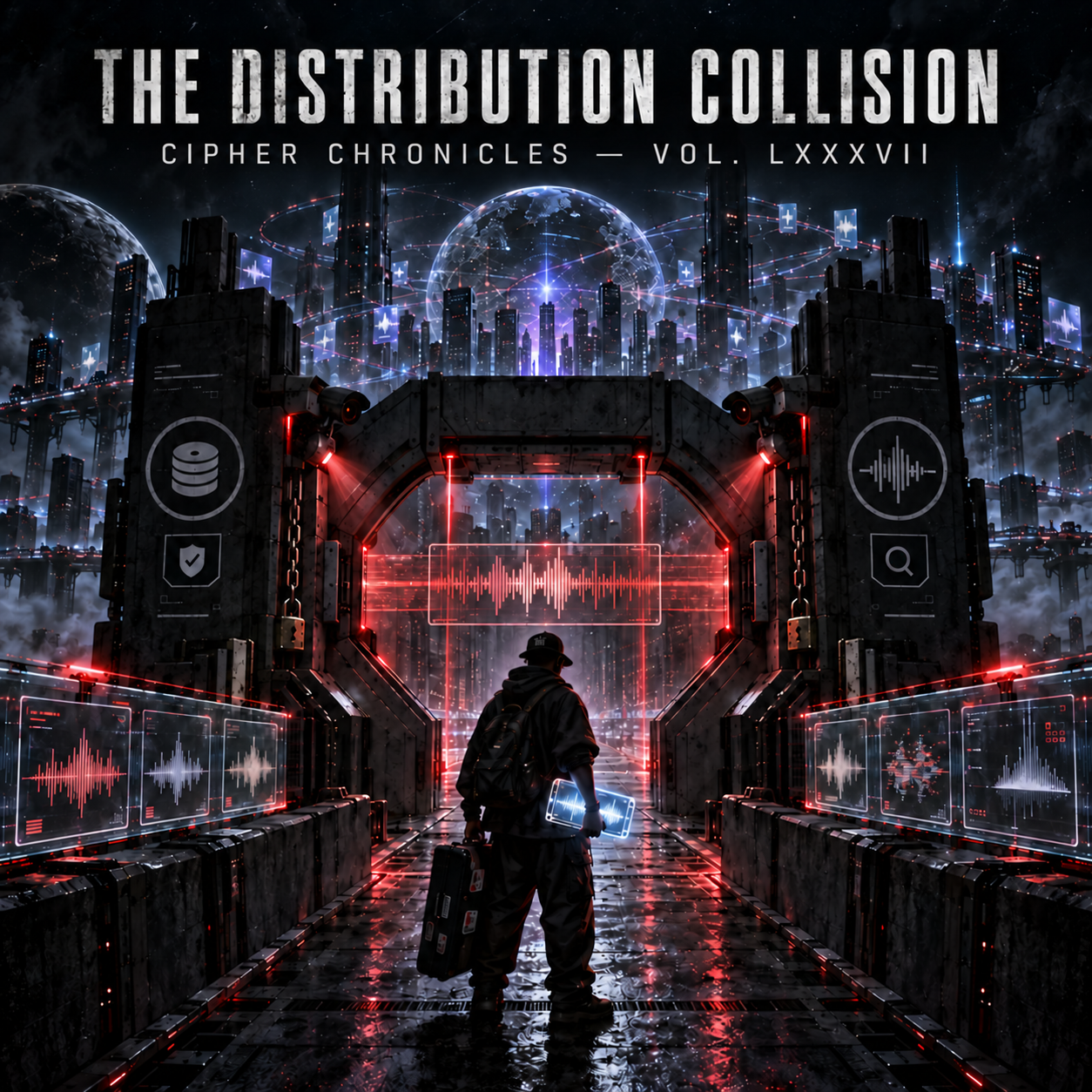
The UMG vs. DistroKid lawsuit is about more than AI-generated music. It raises a larger question for independent artists: how much power should music distributors have to screen, delay, or block releases before they reach streaming platforms?
// PREREQUISITE PROTOCOL //
Before decrypting this file, read The Ownership Collision — Volume LXXX to understand the limitations of automated audio recognition and rights verification.
// SYSTEM ALERT: DISTRIBUTION GATEWAY UNDER DISPUTE. RIGHTS VERIFICATION ACTIVE. //
I. [UMG VS. DISTROKID]
Universal Music Group filed suit against DistroKid in Delaware federal court on September 15, 2026.
The complaint alleges copyright infringement and deceptive trade practices. UMG says DistroKid violated its rights in at least 1,000 recordings, including unauthorized versions, altered tracks, and music containing uncleared samples.
The theoretical statutory ceiling is $150 million in damages if UMG proves willful infringement involving 1,000 eligible works and the court awards the maximum of $150,000 for each one.
DistroKid says it takes copyright protection and fraud prevention seriously. It expressed disappointment that UMG chose litigation instead of established industry processes, denied the allegations, and said it intends to defend itself.
II. [WHY MUSIC DISTRIBUTORS ARE BECOMING GATEKEEPERS]
This matters beyond two companies fighting in federal court.
Music distributors sit between independent creators and global streaming platforms.
DIY distribution lowered the barrier to releasing music without a traditional label. Now distributors are increasingly expected to detect fraud, copyright infringement, suspicious upload patterns, impersonation, and material that violates streaming-platform rules.
The pipe is becoming a checkpoint.
The question is how much responsibility distributors should carry for deciding what reaches listeners and what evidence artists should receive when a release is stopped.
III. [DISTROKID'S AI MUSIC POLICY]
DistroKid does not categorically prohibit AI-generated music.
Its published policy allows music created with AI tools when the uploader owns the necessary rights and follows streaming-service requirements. DistroKid prohibits unauthorized impersonation, infringement, and mass-generated spam intended to manipulate algorithms or flood streaming platforms.
DistroKid also offers AI credits for disclosing AI-generated lyrics, vocals, instrumental performances, compositions, or other audio. It distinguishes generated content from tools used for pitch correction, mixing, mastering, and other AI-assisted workflows.
That distinction matters. AI use alone does not establish infringement, but using AI does not erase copyright, licensing, consent, or disclosure requirements.
IV. [LICENSED AI MUSIC AND THE PERMISSION LAYER]
Five days before the lawsuit was filed, UMG announced a multi-year licensing partnership with ElevenLabs. The companies said the planned platform would allow fans to create authorized remixes, mashups, new interpretations, and personalized vocal experiences using music from participating artists and songwriters.
That partnership neither disproves UMG's allegations nor makes its position automatically hypocritical.
It reveals the dividing layer.
// CORRELATION //
AI USE ≠ AUTOMATIC INFRINGEMENT
AI USE ≠ AUTOMATIC AUTHORIZATION
THE DIVIDING LAYER IS RIGHTS.
WHO OWNS IT?
WHO AUTHORIZED IT?
WHO GETS COMPENSATED?
WHO DECIDES WHETHER IT PASSES THE GATE?
V. [THE AI MUSIC WAR]
The UMG vs. DistroKid lawsuit is one part of a larger fight already unfolding across the music industry.
That same conflict is the focus of EP. 002 of The Cipher Chronicles Podcast: The AI Music War — Suno, DistroKid & Who Owns the Future?.
Hosted by Grim Logick, the episode expands beyond this lawsuit into the disputes surrounding Suno, generative AI, training data, licensing, voice cloning, distributor policies, metadata, ownership, and the independent artists caught between them.
The episode approaches AI from inside the independent music ecosystem rather than reducing the issue to "AI good" or "AI bad."
Grim also addresses his own use of AI-assisted production and the line he draws between technology assisting a human creator and technology being used to replace, impersonate, or exploit one.
That brings the larger conflict back to the same questions underneath this case:
Who made the music?
Who owns the result?
What was the AI trained on?
Who consented?
Who gets paid?
And who controls whether that music reaches listeners?
// BROADCAST CORRELATION //
LAWSUIT: UMG VS. DISTROKID
LARGER CONFLICT: AI MUSIC OWNERSHIP
TOOL: CHANGING
RESPONSIBILITY: REMAINS
GATEKEEPERS: MULTIPLYING
The lawsuit examines one distribution gate.
The podcast examines the system forming around it.
VI. [FROM CONTENT ID TO DISTRIBUTION SCREENING]
The Ownership Collision — Volume LXXX established the underlying problem.
Audio-recognition systems can detect similarity.
They cannot automatically understand every license, collaboration, cleared sample, remix agreement, beat lease, or legitimate ownership relationship behind that similarity.
The UMG vs. DistroKid lawsuit moves the same problem upstream.
Instead of asking whether a streaming platform should remove something after release, the question becomes whether a music distributor should stop it before release.
Detection is easier than understanding rights.
VII. [THE FALSE-POSITIVE RISK FOR INDEPENDENT ARTISTS]
If distributors respond with stricter upload screening, legitimate releases could be delayed or incorrectly flagged. Artists may face broader AI-disclosure requirements, additional ownership checks, or another layer of review before release day.
Appeals would become increasingly important when automated systems get something wrong.
There is currently no confirmed lawsuit-related requirement for ordinary artists to change distributors, pay new fees, or prove ownership of every stem they upload.
But stricter distribution gates create a basic risk:
// SYSTEM RISK //
TOO LOOSE:
INFRINGING MATERIAL GETS THROUGH.
TOO AGGRESSIVE:
LEGITIMATE MATERIAL GETS CAUGHT.
VIII. [WHAT INDEPENDENT ARTISTS NEED]
Independent artists need systems capable of stopping stolen masters, cloned vocals, unauthorized beats, fraudulent uploads, and deliberate copyright infringement.
They also need protection when those systems make mistakes.
A legitimate release should not be blocked because automated screening misunderstood a collaboration, license, cleared sample, remix, beat lease, or AI-assisted workflow.
Functional enforcement requires detection, evidence, explanation, and a meaningful appeal process.
Artists can reduce avoidable disputes by preserving beat licenses, sample clearances, collaboration agreements, split sheets, session files, stems, and written permission connected to each release. Those records cannot prevent every false positive, but they can make an appeal easier to prove.
IX. [FINAL READ: THE FUTURE OF MUSIC DISTRIBUTION]
This is not fundamentally an AI story.
It is a gatekeeping and ownership story.
The real question is whether music distribution systems can distinguish infringement from legitimate creation accurately enough to protect rights without making independent artists collateral damage.
The lawsuit shows what happens when that question reaches the distribution gate.
The AI Music War follows it outward into the larger system of training data, licensing, synthetic voices, ownership, compensation, and control.
The tool has changed.
The responsibility hasn't.
// DISTRIBUTION GATE: CONTESTED
// RIGHTS LAYER: ACTIVE
// AI MUSIC WAR: ACTIVE
// ARTIST ACCESS: UNRESOLVED
// END TRANSMISSION //
OFFICIAL REFERENCE FILES
- Reuters: UMG Sues DistroKid Over Allegedly Unauthorized and AI-Generated Music
- DistroKid: Uploading Music Made With AI Tools
- DistroKid: What Are AI Credits?
- DistroKid: How to Fill Out AI Credits
- Universal Music Group and ElevenLabs Licensing Agreement
- 17 U.S.C. § 504: Copyright Damages
- The Cipher Chronicles Podcast — EP. 002: The AI Music War — Suno, DistroKid & Who Owns the Future?