“THE INVISIBLE COMMISSION - VOL. LXXXVIII” | HILMA AF KLINT, THE HIGH MASTERS & THE PAINTINGS FOR THE TEMPLE | CIPHER CHRONICLES: [SOURCE CODE]
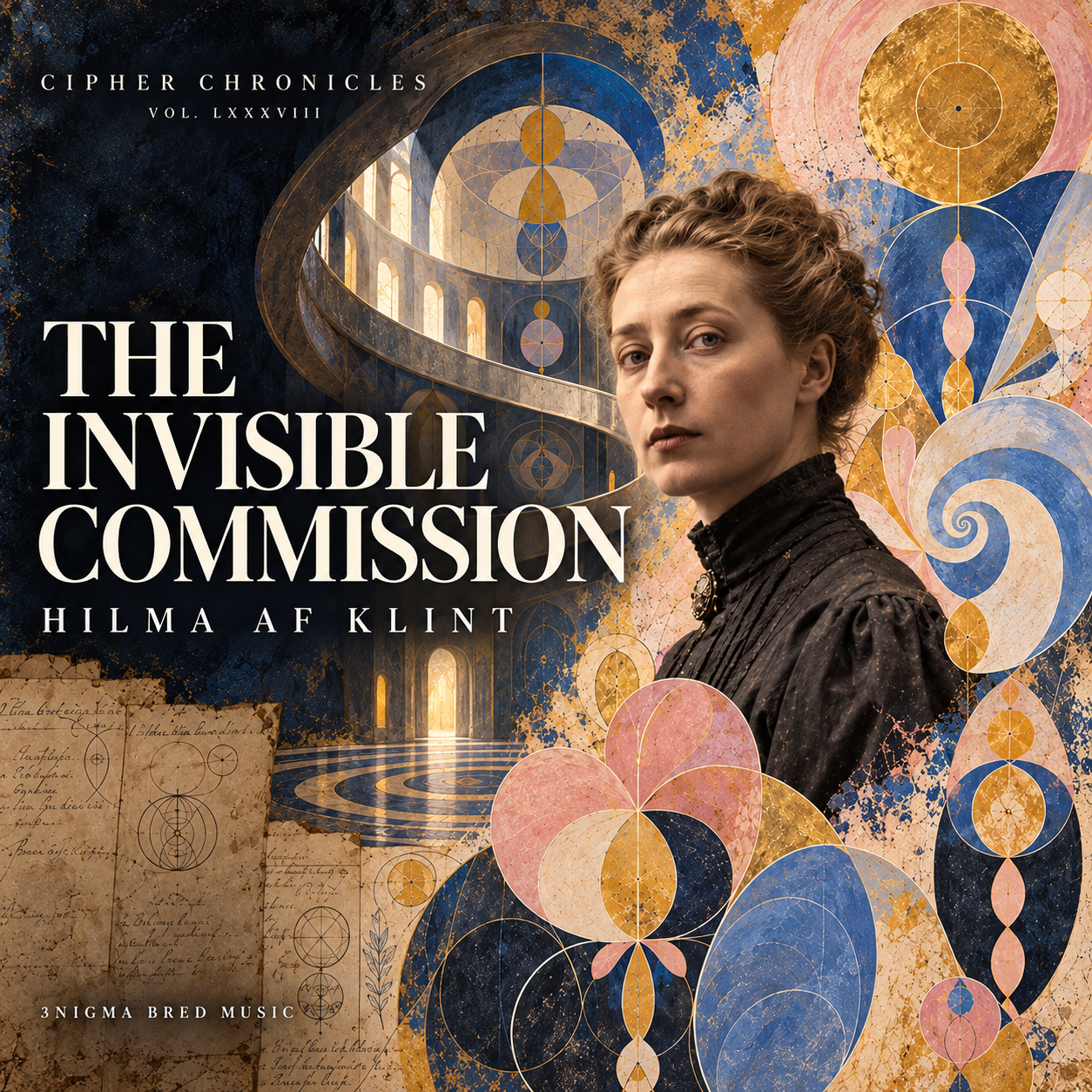
For new readers: Hilma af Klint was a professionally trained Swedish artist who painted landscapes, portraits, botanical studies, and other conventional work.
Then another body of work began.
In 1906, af Klint believed a spiritual being named Amaliel offered her a commission.
She accepted.
Over the next nine years, with a four-year interruption, The Paintings for the Temple grew into 193 works depicting forces, stages of existence, dualities, evolution, and realities af Klint believed extended beyond the visible world.
Some of those paintings appeared years before the canonical breakthroughs of artists usually associated with the emergence of abstraction.
But calling af Klint an abstract artist only tells us part of the story.
She believed she was painting something real.
Just not something everyone could see.
// VISUAL SIGNAL DETECTED //
SOURCE: INVISIBLE
MEDIUM: PAINT
COMMISSIONER: AMALIEL
DESTINATION: A TEMPLE THAT IS NOT TANGIBLE
I. [THE ARTIST THE WORLD DID KNOW]
Hilma af Klint was born in Sweden in 1862.
In 1882, she began studying at Stockholm's Royal Academy of Fine Arts. Between 1886 and 1914, she exhibited conventional paintings in more than two dozen exhibitions.
She knew how to operate inside the established art world.
Portraits, landscapes, botanical subjects, anatomical illustration, academic technique.
The mystery begins because she developed another practice alongside that career.
One that was never meant to function like ordinary painting.
II. [THE FIVE OPEN A CHANNEL]
In 1896, af Klint joined four other women in a spiritual circle called The Five, or De Fem:
Anna Cassel.
Cornelia Cederberg.
Sigrid Hedman.
Mathilda Nilsson.
Hilma af Klint.
They met for prayer, meditation, séances, automatic writing, and automatic drawing. Their meetings were recorded in notebooks.
The women believed they were receiving communications from spiritual beings, including Amaliel, Ananda, and Gregor, whom they understood as intermediaries connected to higher entities called the High Masters.
That distinction matters.
The notebooks preserve the practice, the names, and what the women believed was happening.
// CHANNEL STATUS //
THE FIVE: DOCUMENTED
PRACTICES: PRESERVED
HISTORY: INTACT
HIGH MASTERS: RECORDED BELIEF
III. [THE INVISIBLE COMMISSION]
In 1904, af Klint recorded a prediction from the being she called Ananda concerning the creation of "astral paintings."
Then came Amaliel.
According to af Klint's records, in January 1906 she was offered a larger artistic commission.
She accepted immediately.
By November, she had begun Primordial Chaos, the first series within what became The Paintings for the Temple.
The other women of The Five did not accept the commission and warned af Klint about the intensity of the spiritual undertaking. Af Klint continued anyway.
By 1915, she had completed the cycle.
This changes how the usual story of abstraction begins.
Af Klint was not initially announcing that she had invented a new movement.
She believed she had been given a job.
IV. [THE HAND HOLDING THE BRUSH]
This presents the larger question:
Who did Hilma af Klint believe was actually creating these paintings?
Her own descriptions refuse to give us one clean answer.
During the earlier phase, she described some works as arriving directly through her. She said she could work rapidly without prior sketches and zero initial knowledge of what the images were supposed to depict.
But she also described something less passive.
She wrote that she was not expected simply to obey the High Masters blindly. Instead, she imagined them standing beside her as she worked.
After pausing The Paintings for the Temple in 1908, her relationship to the process changed further. When she returned to the project in 1912, her own artistic control became more pronounced. The Guggenheim notes that by 1917 she had stopped producing art through a spirit altogether.
So "the spirits painted through her" is too simple.
Was she receiving?
Interpreting?
Using spiritualism as a method of tapping into a frequency she would not have otherwise been able to access?
Did inspiration feel external even when human hands still had to execute the plan?
The archive records the experience.
It does not solve it.
V. [THE TEN LARGEST]
Before that shift in her process came a shift in scale.
In 1907, during the earlier phase of The Paintings for the Temple, af Klint created The Ten Largest.
Each stands more than three meters tall.
Together they trace four stages of human life:
Childhood.
Youth.
Adulthood.
Old age.
Across them appear spirals, circles, flowers, organic forms, letters, cellular shapes, and enormous fields of color.
These were not tiny automatic drawings hidden inside séance notebooks.
They were monumental.
The Guggenheim's teaching guide describes af Klint completing the series in just over sixty days with one female assistant who was not a member of The Five.
The viewer is not simply looking at the image.
The image surrounds the viewer.
And af Klint believed these paintings belonged inside something larger.
VI. [THE TEMPLE THAT WAS NEVER BUILT]
The works were not conceived merely as separate paintings.
Together, they formed The Paintings for the Temple.
Af Klint eventually developed sketches for a spiral-shaped temple building, intended for the island of Ven in the Öresund. In 1932, she described another idea for a museum intended to reveal what existed behind the forces of matter.
Neither building materialized.
The temple remained on paper.
Then, decades after her death, something visually strange happened.
In 2018, the Solomon R. Guggenheim Museum opened Hilma af Klint: Paintings for the Future.
Her paintings entered one of the most recognizable spiral exhibition spaces in the world.
The resemblance is a historical and architectural correlation.
To us, it also reads as a vision finding physical form.
An artist spent years creating paintings for an unrealized spiral temple.
A century later, those paintings climbed the walls of a spiral museum.
// ARCHITECTURAL CORRELATION //
INTENDED TEMPLE: SPIRAL
PHYSICAL TEMPLE: NEVER BUILT
GUGGENHEIM ROTUNDA: REALITY MANIFESTED
VII. [THE TWENTY-YEAR INSTRUCTION]
The popular story gets cleaner from here than the archive allows.
Af Klint supposedly hid her strange paintings away and ordered that nobody see them until twenty years after her death.
Something close to that happened.
But not exactly.
In 1932, she marked numerous notebooks, including the Blue Books documenting The Paintings for the Temple, with an X indicating that they were not to be opened until twenty years after her death.
But she did not spend her entire life hiding every spiritual work.
She showed seventeen spiritual paintings at a Theosophical Society exhibition in Stockholm in 1913. In 1928, she showed works from The Paintings for the Temple in London. She sought advice concerning how the paintings might eventually be used, and in 1937 asked the Anthroposophical Society in Stockholm to make use of them.
Her notebooks indicate that she believed the broader world was not yet ready for their message.
That is more interesting than a locked-room legend.
Af Klint was not simply hiding the work.
She was controlling when and how a larger audience would encounter it.
VIII. [WHO INVENTED ABSTRACTION?]
This is where af Klint collides with art history.
She began producing radically nonfigurative paintings in 1906.
That predates the major abstract breakthroughs traditionally associated with Wassily Kandinsky, Piet Mondrian, Kazimir Malevich, and other canonical modernists. The Guggenheim places her nonobjective work several years before comparable developments among those artists.
So was Hilma af Klint the first abstract artist?
The chronology makes the question legitimate.
The answer is less simple.
Kandinsky and the other modernists participated in the public development of abstraction as an artistic movement.
Af Klint's project emerged largely through spiritual practice and remained mostly outside that conversation.
The word "abstract" describes something about the paintings.
It does not explain everything af Klint believed she was doing.
Spiritual purpose and abstraction could coexist. Kandinsky and Mondrian also explored spiritual ideas in their work.
Af Klint believed she was making the invisible visible.
Her circles, spirals, colors, symbols, and geometric relationships carried meanings tied to spiritual forces and structures of existence.
The question is what those forms represented to the person painting them.
She believed she was painting another layer of reality.
// CATEGORY COLLISION //
NONFIGURATIVE WORK: DOCUMENTED BY 1906
ART HISTORY'S TIMELINE: CHALLENGED
"FIRST ABSTRACT ARTIST": INTERPRETATION
ARTIST'S INTENTION: SPIRITUAL REPRESENTATION
IX. [THE FUTURE FINALLY ARRIVES]
Hilma af Klint died in 1944.
Her nephew Erik af Klint inherited an enormous archive:
approximately 1,300 paintings.
124 notebooks.
More than 26,000 handwritten and typed pages.
For decades, the work remained outside the center of modern art history.
Then the audience began catching up.
Her inclusion in the 1986 exhibition The Spiritual in Art: Abstract Painting 1890–1985 helped introduce the work to a broader institutional audience.
Three decades later came the Guggenheim.
Hilma af Klint: Paintings for the Future ultimately drew more than 600,000 visitors, becoming the most-visited exhibition in the Solomon R. Guggenheim Museum's history at that time.
The woman who believed her complete project belonged to a future audience finally had one.
And that audience encountered an uncomfortable problem.
The history of abstraction had already been written.
Af Klint's paintings had existed before much of it.
X. [FINAL READ]
An established artist believed she had been asked to give visible form to realities other people could not see. She spent years completing that commission, imagined a temple capable of containing it, restricted parts of the archive for a future audience, and died before that audience truly arrived.
Art history later called much of what she created abstraction.
That description can coexist with what Hilma af Klint believed she was doing.
Giving form to reality.
Just a part of reality that remained invisible for a century.
// END TRANSMISSION //