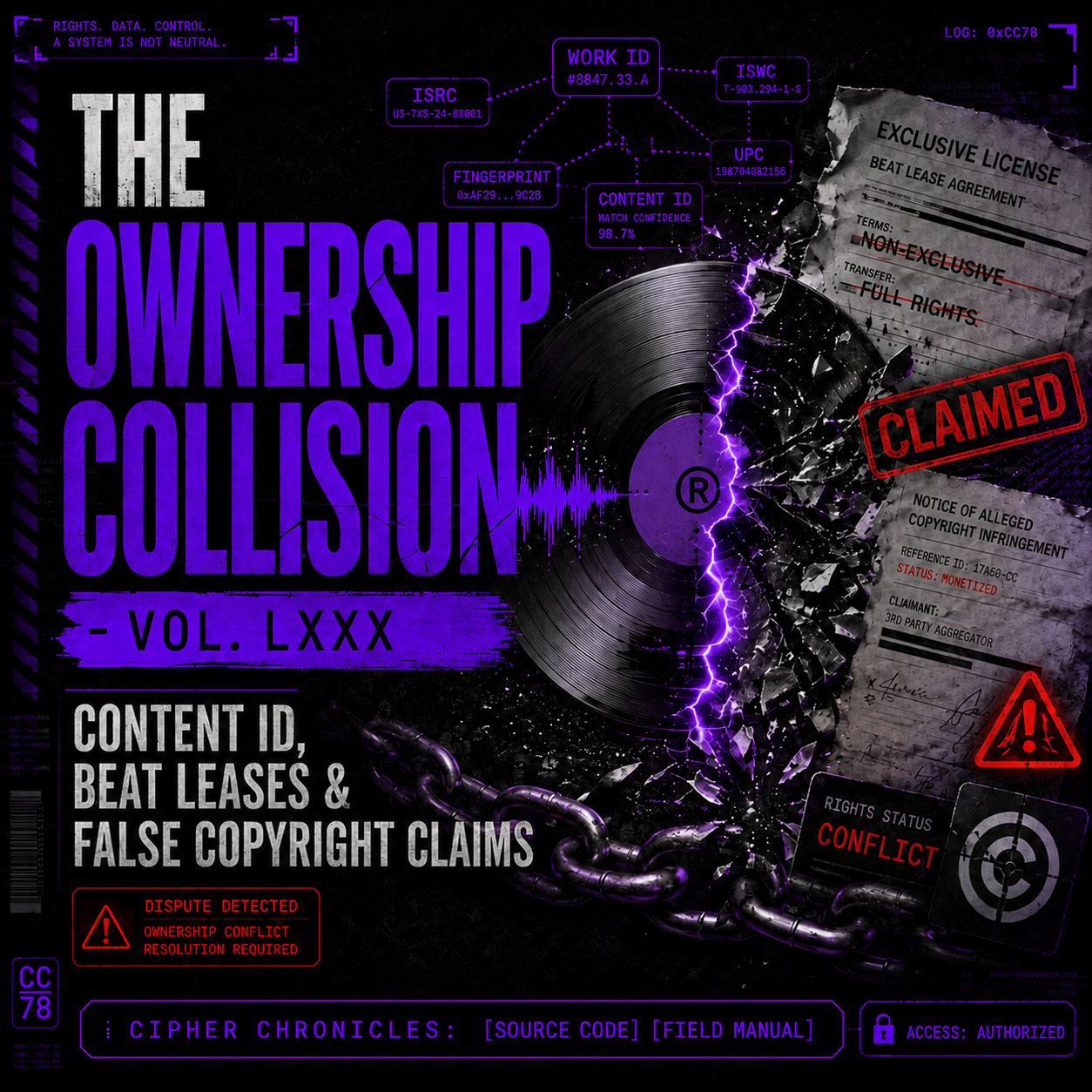
“THE OWNERSHIP COLLISION - VOL. LXXX” | CONTENT ID, BEAT LEASES & FALSE COPYRIGHT CLAIMS | CIPHER CHRONICLES: [SOURCE CODE] [FIELD MANUAL]
Content ID can recognize matching audio in seconds.
It cannot read a beat license.
It cannot verify a split sheet.
It cannot interpret the agreement between a producer and an artist.
And it cannot determine ownership simply because two recordings share the same sound.
That distinction becomes important once several systems begin touching the same release. Distributors and publishing administrators can overlap with licensed instrumentals, collaborators, and automated copyright enforcement.
An independent artist can legally own a recording and still receive a Content ID claim.
The claim may be legitimate.
It may be administrative.
It may result from shared source material.
It may also be wrong.
The difficulty is that all four can initially look almost identical on a screen.
Automation recognizes similarity.
Ownership requires context.
«// SYSTEM NOTICE: THE FOLLOWING IS OPERATIONAL EDUCATION, NOT FORMAL LEGAL ADVICE. CONSULT QUALIFIED COUNSEL FOR CONTRACTUAL OR COPYRIGHT DISPUTES. //»
// SYSTEM ALERT // OWNERSHIP COLLISION DETECTED.
An artist writes a song and licenses the production. They record the vocals, fund the release, and upload the official video.
Then a notification arrives identifying somebody else as a rights holder.
At first glance, the conclusion feels obvious.
Somebody stole the song.
But copyright administration is rarely that simple.
The claimant could be another artist using the same beat. It could be the producer’s publishing administrator. It could be a distributor the artist personally authorized months earlier and forgot was managing Content ID.
Or it could actually be an invalid claim.
Before deciding which story is true, the artist has to understand what the machine is actually reporting.
// INDEXOR-PRIME // CORRELATION 01
AUDIO MATCH: CONFIRMED.
OWNERSHIP: UNRESOLVED.
The system has identified a similarity.
It has not identified the agreement behind it.
// INDEX CONTINUES //
I. [THE AUTOMATED JUDGE] RECOGNITION IS NOT ADJUDICATION
YouTube Content ID compares uploaded videos against reference material supplied by copyright owners and rights-management partners.
When matching material is detected, the claimant’s policy may monetize the video, track its performance, or block it. Those actions can also vary by territory.
A Content ID claim is not the same thing as a copyright strike.
Claims usually affect the video itself. A copyright strike generally follows a valid copyright removal request and can affect the channel.
That difference sounds elementary until a creator receives the notification.
The language of copyright enforcement carries weight. Seeing another company or artist attached to your own music can immediately feel accusatory.
But a claim is information before it is a conclusion.
Music also contains more than one layer of rights.
The sound recording concerns the recorded master.
The composition concerns the underlying melody, lyrics, and musical work.
Those rights can overlap without belonging entirely to the same people.
An artist may control the finished master while a producer or songwriter retains part of the composition. A publishing administrator representing that share may therefore appear beside a video even when the artist had every legal right to release the song.
The existence of a claim does not answer the ownership question.
It tells you where to start asking it.
// INDEXOR-PRIME // CLAIM CLASSIFICATION
MASTER.
COMPOSITION.
ADMINISTRATIVE.
REMOVAL REQUEST.
Similar notifications can represent different rights.
Classification precedes reaction.
// RETURNING FILE //
Before disputing anything, identify the claimant. Check what portion of the video matched. Determine whether the video is being monetized, tracked, or blocked.
Then determine what right the claimant appears to represent.
The first mistake in a copyright dispute is often assuming the notification has already explained more than it actually has.
II. [THE MIRROR CLAIM] WHEN THE SYSTEM RECOGNIZES YOU AS SOMEBODY ELSE
There is a particularly strange version of this problem where nobody has actually taken anything.
The artist uploads a song through a distributor.
The artist activates that distributor’s Content ID service.
The distributor registers the eligible recording.
Later, the artist uploads the official music video to YouTube.
Content ID recognizes the music.
The artist receives a copyright claim against their own video.
Technically, nothing has gone wrong.
The system has done exactly what it was instructed to do.
DistroKid currently explains that artists using its YouTube Content ID service may receive claims from Interstreet Recordings on videos containing their own music. Interstreet helps power DistroKid’s Content ID service, and the resulting eligible revenue is routed back through DistroKid.
That distinction matters because the claimant name alone may not reveal the relationship.
A company you do not immediately recognize may still be acting through a service you authorized.
DistroKid also allows individual videos to be added to its YouTube Allowlist after a Content ID claim has appeared. Entire channels cannot currently be allowlisted through that system.
So when an official video receives a claim, the useful question is not simply:
Who claimed my music?
It is:
Who is this claimant acting for, and where is the revenue going?
Those are very different questions.
A mirror claim can feel like theft because the interface places the artist on one side and a claimant on the other.
That visual opposition does not necessarily reflect the actual ownership relationship.
// INDEXOR-PRIME // SOURCE TRACE
CLAIMANT LOCATED.
ADMINISTRATOR RELATIONSHIP: AUTHORIZED.
CONFLICT STATUS: APPARENT.
OWNERSHIP CONFLICT: NOT ESTABLISHED.
Recognition without context creates suspicion.
Trace the source before assigning intent.
// INDEX CLOSED //
III. [THE LEASE COLLISION] PERMISSION IS NOT EXCLUSIVITY
The situation becomes more complicated when the source material itself is shared.
A producer creates a beat and offers it through non-exclusive licenses.
Artist One leases it.
Artist Two leases it.
Both artists receive permission to record songs, distribute their masters, and monetize their releases according to their respective agreements.
Nothing unusual has happened yet.
Then Artist One registers a finished song with Content ID.
Artist Two uploads a music video.
The shared instrumental creates a match.
Now one legally licensed artist appears to be infringing another legally licensed artist.
This is where the difference between permission and exclusive control becomes critical.
A beat license may give an artist broad commercial rights without transferring exclusive ownership of the underlying production.
YouTube’s Content ID eligibility rules generally require the party supplying reference material to hold exclusive rights to the material being evaluated. YouTube specifically identifies non-exclusive material as something that may not qualify.
Individual distributors can impose even stricter requirements.
DistroKid currently states that artists submitting music to its YouTube Content ID service must create 100% of the sounds in the release. Releases are also ineligible when they contain outside beats or sample-library material. The same restriction applies to loops, samples, sound effects, and other third-party audio.
That means the phrase “commercial use” should never be mentally translated into “exclusive Content ID ownership.”
Those concepts are not interchangeable.
A license may authorize distribution.
It may authorize monetization.
It may authorize music videos and live performance.
None of those permissions automatically establish the right to present shared source material to an automated system as exclusively controlled.
// INDEXOR-PRIME // LICENSE COMPARISON
PERMISSION TO RELEASE: POSSIBLE.
PERMISSION TO MONETIZE: POSSIBLE.
EXCLUSIVE CONTROL: SEPARATE QUESTION.
CONTENT ID AUTHORITY: SEPARATE QUESTION.
Do not expand a contract by assumption.
// CONTRACT FILE RESTORED //
Before activating Content ID on a recording built from licensed production, the artist should know exactly what the agreement permits.
Look specifically for terms covering:
- Content ID
- Exclusivity
- Third-party rights management
- User-generated-content monetization
- Samples
- Shared production
If the contract does not address an important permission, guessing is a poor substitute for clarification.
Most ownership collisions do not begin because two people listened to the same audio differently.
They begin because two people interpreted the same permission differently.
IV. [THE EVIDENCE VAULT] MEMORY IS NOT A RIGHTS DATABASE
Independent music moves quickly.
A beat gets purchased through one website.
The producer conversation happens through direct messages.
Splits get discussed on the phone.
Files move through email.
A collaborator sends stems through a cloud link.
Six months later, everybody remembers the agreement.
Two years later, everybody remembers a slightly different agreement.
This is where documentation becomes less glamorous and considerably more valuable.
Before releasing music, preserve the material that explains how the song came into existence.
That includes:
- Beat licenses and receipts
- Producer agreements
- Signed split sheets
- Collaboration agreements
- Sample permissions
- Original project files
- Raw vocals and stems
- Dated exports
- ISRC and UPC information
- Writer and producer credits
- Master ownership records
- Emails or messages establishing permissions
- Distributor settings
- Content ID settings
The purpose is not to accumulate paperwork for the sake of appearing professional.
The purpose is to preserve context while everybody still agrees on what happened.
A distributor’s royalty-splitting feature can divide payments. It cannot independently establish the entire legal relationship behind those percentages.
Payments and ownership are related.
They are not synonymous.
The Financial Override - Vol. LVII examined how master royalties, publishing royalties, and digital-performance royalties travel through different systems. Once those systems begin moving money separately, undocumented assumptions become increasingly difficult to reconstruct.
A useful ownership file should be able to answer a small group of questions without relying on anybody’s memory:
Who controls the master?
Who owns the composition?
How are the agreed shares divided?
Who may register the recording with a rights-management service?
Does the recording contain material licensed non-exclusively?
Who is responsible for future claims or disputes?
// INDEXOR-PRIME // EVIDENCE REVIEW
RECEIPT WITHOUT TERMS: INCOMPLETE.
SPLIT WITHOUT AGREEMENT: INCOMPLETE.
MEMORY WITHOUT DOCUMENTATION: UNVERIFIABLE.
The strongest version of the story is the version preserved before conflict changes it.
// EVIDENCE VAULT SECURED //
Documentation does not prevent every disagreement.
It does something more practical.
It prevents the disagreement from becoming the only surviving record.
V. [THE DISPUTE PROTOCOL] CERTAINTY AND EVIDENCE ARE NOT THE SAME THING
YouTube allows uploaders to dispute Content ID claims when they believe they have the necessary rights, the content was misidentified, or another valid legal basis applies.
Fair use can also be relevant in some cases under U.S. copyright law. Examples can include commentary, criticism, teaching, and scholarship. Research and news reporting can also qualify depending on context.
But fair use is contextual.
Giving credit is not automatically fair use.
Owning a copy is not automatically fair use.
Choosing not to monetize something does not establish permission.
There is an important philosophical difference between believing you are right and being able to explain why you are right.
Copyright disputes live inside that difference.
Before submitting one, identify the claimant and the matched material.
Review the license.
Review collaborator agreements.
Determine whether the claim originated from a service you already authorized.
If the issue involves a producer, songwriter, or collaborator who can resolve the problem directly, communication may accomplish more than immediate escalation.
Then, if the evidence supports the dispute, submit it clearly.
The claimant currently has up to 30 days to respond to an initial Content ID dispute.
They may release the claim, allow it to expire, reinstate it, or pursue a copyright removal request.
The process becomes more serious at the appeal stage.
[THE APPEAL RISK]
If an initial dispute is rejected, an eligible creator may be able to appeal.
After an appeal is submitted, the claimant currently has seven days to respond.
At that stage, continuing enforcement can involve a formal copyright removal request.
If YouTube processes a valid standard removal request, the video can be removed and the channel can receive a copyright strike.
A scheduled removal request may provide a seven-day period in which the uploader can cancel the appeal before the removal and strike take effect. Canceling that appeal can leave the original Content ID claim in place.
This is why escalation deserves more consideration than emotion.
The existence of an Appeal button does not mean pressing it is the next required step.
// INDEXOR-PRIME // ESCALATION GATE
CONFIDENCE: NOT MEASURABLE.
DOCUMENTATION: MEASURABLE.
ANGER: NOT EVIDENCE.
CERTAINTY: NOT EVIDENCE.
Appeal changes the consequences.
Review accordingly.
// GATE RELEASED //
There are situations where an appeal is completely justified.
There are also situations where the artist discovers, during the process of gathering evidence, that the original understanding of the rights was incomplete.
Finding that out is not defeat.
It is information.
The goal should not be winning every dispute.
The goal should be understanding the rights well enough to know which disputes are worth having.
VI. [THE PRE-RELEASE FIREWALL] THE BEST DISPUTE HAPPENS BEFORE THE CLAIM
There is a tendency to think copyright administration begins after a song is finished.
In reality, the important decisions usually happen earlier.
Before Content ID is activated, the people involved should know what material exists inside the recording and what permissions came with it.
Ask:
SOURCE MATERIAL
Who created each significant part of the recording?
BEAT LICENSE
Does the agreement address Content ID or exclusive rights?
SAMPLES AND LOOPS
Does the recording contain material that makes it ineligible for the selected rights-management service?
COLLABORATORS
Are the writing and ownership shares documented?
ADMINISTRATOR
Is more than one company attempting to register the same master?
OFFICIAL VIDEOS
How will the chosen administrator treat the artist’s own uploads?
OWNERSHIP CHAIN
Can each claimed right be traced back to an agreement, creation, or transfer?
Those questions are less exciting than finishing a mix.
They are also considerably less painful than reconstructing the answers after revenue has been redirected or a video has been blocked.
A song can be creatively complete while its rights remain administratively unfinished.
Both matter.
[FINAL READ] THE OWNERSHIP COLLISION
Content ID solves an enormous technical problem.
Millions of uploads cannot be manually compared against millions of copyrighted recordings by human beings.
Audio fingerprinting makes recognition possible at scale.
But recognition and interpretation are different abilities.
The system can identify where two recordings intersect.
It cannot explain why they intersect.
It does not know that two artists licensed the same instrumental.
It does not understand the conversation that established a publishing split.
It cannot tell whether an unfamiliar claimant is an authorized administrator or somebody asserting rights they do not possess.
And YouTube itself does not decide those underlying ownership disputes.
That context exists somewhere else.
It exists in the license.
The agreement.
The split sheet.
The original files.
The correspondence.
The documented chain connecting a piece of music to the people who created and control it.
Automation can recognize similarity.
Ownership requires context.
And when the context is undocumented, the machine does not always create the confusion.
Sometimes it simply exposes confusion that was already there.
// INDEXOR-PRIME // FINAL CORRELATION
AUDIO FINGERPRINT: MACHINE-READABLE.
AGREEMENT: CONTEXT-DEPENDENT.
OWNERSHIP CHAIN: DOCUMENT-DEPENDENT.
SIMILARITY DOES NOT RESOLVE AUTHORITY.
The signal was recognized.
The rights must still be understood.
// FINAL INDEX COMPLETE //
Protect the work before it becomes a dispute.
Know what you own.
Know what you licensed.
Know what you shared.
Know who you authorized.
And preserve the evidence while the story is still easy to tell.
// OWNERSHIP STATUS: DOCUMENTED
// LICENSE STATUS: VERIFIED
// EVIDENCE VAULT: SECURED
// CREATOR SIGNAL: PROTECTED
// END TRANSMISSION //
RELATED CIPHER CHRONICLES FILES
- The Metadata Matrix - Vol. LXIV
The Cipher Chronicles field file covering metadata, credits, and digital identity across music platforms. - The Distribution Gateway - Vol. LX
The distribution protocol explaining how independent music enters streaming platforms through digital distributors. - The Financial Override - Vol. LVII
The royalty field manual covering master, publishing, and digital-performance income. - The Industrialization of Fraud - Vol. XLIX
The Source Code file examining automated exploitation and deceptive activity inside the digital music economy.
OFFICIAL REFERENCE FILES
- YouTube: Learn About Content ID Claims
YouTube’s official explanation of Content ID claims, monetization, tracking, blocking, and the distinction between claims and copyright strikes. - YouTube: Content ID Eligibility
YouTube’s requirements concerning exclusive rights and eligible reference material. - YouTube: Dispute a Content ID Claim
YouTube’s official explanation of initial disputes and the current claimant response period. - YouTube: Appeal a Content ID Claim
YouTube’s explanation of appeals, copyright removal requests, the current seven-day response period, and strike risk. - DistroKid: YouTube Content ID Eligibility
DistroKid’s eligibility requirements for Content ID through its Social Media Pack. - DistroKid: YouTube Content ID / Allowlist
DistroKid’s documentation covering Content ID administration and allowlisting individual videos.