"THE METADATA MATRIX - VOL. LXIV" | DECRYPTING THE SEMANTIC WEB & DIGITAL IDENTITY | CIPHER CHRONICLES: [SOURCE CODE]
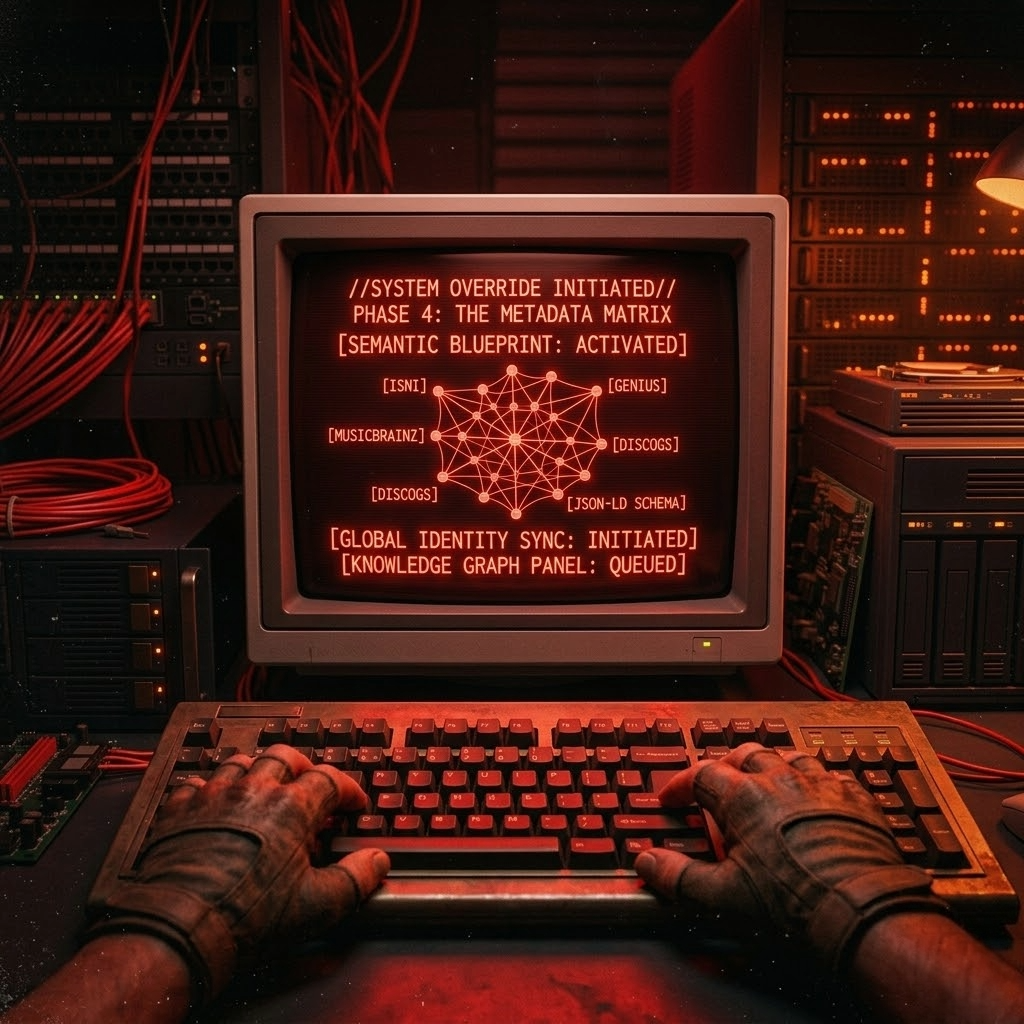
//SYSTEM ALERT// A Spotify upload is not a digital identity. If you do not cement your data into the global semantic web, Google, AI, and Wikipedia will treat you as a ghost. Today, we initiate Phase 4. Learn how to link your ISNI, weaponize MusicBrainz, and build a structured data network that forces the search engines to verify you as a legitimate entity.
//SYSTEM ALERT// INITIATING METADATA MATRIX...
In Vol. LXII, you claimed your territory across the DSPs. The track is live. The audio is streaming. The release exists.
But a live release is not the same thing as a digital identity.
One Spotify profile, one Apple Music listing, one distributor entry, one scattered credit, one missing producer tag, one dead social link, and one half-built website do not create authority. They create debris.
For independent artists, music SEO is no longer just about uploading songs. Search engines need consistent artist metadata, external identifiers, official links, release credits, database entries, and structured data before they can understand the full shape of your creative identity.
You cannot wait for The Mainframe to notice you.
The Mainframe was not built to recognize the underground. It recognizes what has been structured clearly enough that its systems have less room to ignore, misread, or fragment it.
That is the mission.
Not submission.
Architecture.
Today, we initiate Phase 4 of the Autonomy Architecture: The Metadata Matrix. We are mapping the identifiers, databases, credit systems, and structured data weapons independent artists can use to build a digital identity outside the gatekeeper model.
The goal is not to join The Mainframe. The goal is to build enough verified signal that even hostile or indifferent systems are forced to parse your existence correctly.
I. THE ANCHOR: YOUR ISNI
Before you enter the matrix, you need a key. That key is the ISNI, the International Standard Name Identifier.
An ISNI is a global identifier used to distinguish public identities connected to creative work. For independent artists, this matters because names collide. There may be another artist with your stage name, another writer with your government name, another producer with a similar alias, or another catalog entry that gets tangled into yours.
The ISNI helps separate the signal from the static.
It can connect the person collecting royalties, writing songs, producing records, engineering vocals, releasing music, and building a catalog into one recognizable public identity. Registering for an ISNI through platforms like Sound Credit gives you a 16-digit identifier that can become an anchor across databases, credits, releases, and authority systems.
This does not make you famous. It makes you traceable. In the metadata war, traceability is survival.
II. THE CORE DECENTRALIZED NODES
Centralized platforms can change their rules. Corporate credit hubs can pivot. Services can restructure, collapse, hide data, or lock access behind new walls.
That is the lesson: never let one corporate archive hold the only map to your legacy.
The move is to seed the signal across multiple nodes.
1. MusicBrainz: The Engine
MusicBrainz is one of the most important open music metadata databases on the internet. It is not just another artist profile. It is a structured database for artists, releases, recordings, works, labels, and identifiers.
For independent artists, MusicBrainz can help connect:
- Artist name
- Aliases
- Releases
- Recordings
- Works
- Labels
- ISRCs
- UPCs
- ISNI
- IPI numbers
- Official websites
- Streaming links
- Social profiles
- External database IDs
This is where your catalog starts becoming machine-readable.
Create or claim the correct artist entry. Add your releases. Attach your ISRC and UPC codes. Connect your official links. Attach your ISNI once available. Make sure the credits match your real contributions.
MusicBrainz is not about hype. It is about structure.
Structure is how the underground survives the algorithmic fog.
2. Muso.ai: The Credit Ledger
Traditional DSPs usually show the face of the release. They often bury the architects.
Muso.ai operates closer to the credit layer. It tracks music credits, contributors, analytics, and professional attribution across releases. For artists, producers, writers, engineers, and collaborators, that matters.
Claim your profile. Verify your credits. Connect your works. Make sure your production, writing, engineering, and performance contributions do not stay scattered across disconnected fragments.
If you produced the track, that matters. If you wrote the hook, that matters. If you engineered the session, that matters. If you mixed the record, that matters. If you arranged the sound design, that matters.
The Mainframe loves to flatten artists into surface-level names.
The Metadata Matrix restores the architecture underneath.
III. THE LYRIC & DOMAIN AUTHORITY HUBS
Search engines already trust certain domains. We are not bowing to those platforms. We are using their established authority against the silence they helped create.
1. Genius: The Lyric Signal
Genius is more than a lyric site. For independent artists, it can become a high-authority text layer connected to your catalog.
Add your lyrics. Annotate your lines. Explain the meaning behind the work. Connect songs to albums, artists, producers, writers, and collaborators where possible.
Lyrics are not just words on a page. They are searchable identity data. Every title, phrase, theme, collaborator, and annotation can help search engines understand the world around your music.
Do not waste the annotation layer on empty flexing. Use it to document the work.
The Cipher remembers what the algorithm forgets.
2. Bandcamp: The Independent Territory
Bandcamp is one of the strongest independent artist territories because it allows more context than most DSPs.
A strong Bandcamp page can hold:
- Artist bio
- Release descriptions
- Credits
- Lyrics
- Tags
- Artwork
- Merch
- Direct fan relationships
- Catalog presentation
Do not treat it like a dump folder. Treat it like a signal archive.
Write real descriptions. Credit collaborators clearly. Use accurate genre tags. Link your official website and social profiles. Make the catalog readable.
Your Bandcamp should tell the machine and the human the same thing: this artist exists, this catalog is intentional, and this signal has structure.
3. AllMusic: The Legacy Index
AllMusic is a long-standing music database with historical authority. Not every independent artist will qualify for a strong AllMusic presence immediately, and not every submission will result in a detailed profile.
But when applicable, it can add another layer of legitimacy to your public-facing music identity.
The goal is not to chase validation. The goal is to establish consistent reference points across the web.
One profile is fragile. A network of consistent profiles is harder to erase.
IV. POST-RELEASE DATA WEAPONS
Once your release is live, certain databases become more useful because they need a public catalog to reference. This is where the post-release phase begins.
1. Discogs: The Historical Archive
Discogs is one of the most important music database archives for releases, labels, credits, formats, and catalog history.
Even if your release is digital, documenting it correctly can help establish another structured proof of existence.
Add the release. List the format. Include the label. Add credits. Connect artists. Attach artwork where allowed. Make sure titles, dates, and roles match the rest of your metadata.
Discogs is not just for collectors. It is a historical record.
History belongs to the artists who document it before someone else rewrites it.
2. Setlist.fm: The Performance Signal
If you perform live, Setlist.fm can become another structured signal. It documents performance activity, venues, dates, songs, and live history.
For artists building a real-world footprint, this matters. A catalog is one signal. A live history is another.
The system may ignore underground stages, house shows, small venues, DIY events, and local movements, but documentation gives those moments shape.
If you played it, archive it. If the room heard it, document it. If the signal moved through the crowd, leave a trace.
3. Rate Your Music / Sonemic: The Community Layer
Rate Your Music and Sonemic operate as community-driven music databases. This is not the same as an official artist site or distributor page. It is a public catalog layer shaped by listeners, collectors, and music communities.
For independent artists, this can add another searchable reference point when used correctly.
Do not spam it. Do not fake activity. Do not treat community databases like advertising boards.
Seed accurate information where appropriate and let the catalog stand.
The strongest signal is not forced. It is consistent.
V. THE ENDGAME: WIKIDATA, JSON-LD & STRUCTURED DATA
Why are we executing all of this?
Because the final layer of independent artist visibility is not permission. It is resistance through structure.
The Mainframe does not validate the underground because it respects the underground. It recognizes what has been made too consistent, too documented, and too interconnected to ignore.
That is where Wikidata and Schema.org JSON-LD enter the architecture.
But understand this clearly:
Wikidata is not a self-submission portal.
You do not treat it like a press kit. You do not treat it like a fan page. You do not treat it like another profile to fill out because you want a Google Knowledge Panel.
Wikidata is a community-maintained structured database with its own notability standards, sourcing expectations, and editorial culture. If an artist, label, or creative project does not have enough independent, verifiable public data behind it, forcing an entry too early can backfire. The node can be challenged, merged, flagged, or removed.
So the move is not to rush the gate. The move is to build the signal first.
Before Wikidata can become part of your architecture, your external identity should already be reinforced across trusted music and authority databases:
- ISNI
- MusicBrainz
- Discogs
- Spotify artist URI
- Apple Music artist link
- Genius
- Bandcamp
- AllMusic when applicable
- Official website
- Press
- Interviews
- Reviews
- Credits
- Independent coverage
These are not vanity links. They are identity anchors.
They help the wider internet understand that the writer, performer, producer, engineer, label, catalog, releases, and official profiles all connect back to the same real-world creative entity.
Once that footprint is strong enough, Wikidata may become a possible structured-data endpoint.
Not the first weapon.
A later-stage node.
Until then, your own website is the territory you fully control. By embedding Schema.org JSON-LD markup into your site, you can explicitly declare:
This official website, this Spotify profile, this MusicBrainz page, this Discogs listing, this Genius profile, this ISNI, and these verified social profiles all belong to the same artist, label, or creative entity.
That is the real breach.
You are not joining The Mainframe. You are building outside it with enough precision that its systems are forced to parse your existence correctly.
Wikidata may come later. Your metadata consistency, official site, external identifiers, independent coverage, and structured data come first.
VI. THE OFFICIAL WEBSITE: YOUR CONTROLLED TERRITORY
Every database matters, but your official website is the territory you control directly.
Spotify can change its layout. Instagram can bury your posts. Facebook can throttle your reach. X can decay into noise. A database can restructure. A platform can collapse. A profile can disappear.
Your website is your command center.
It should contain:
- Artist bio
- Label bio
- Official discography
- Release pages
- Lyrics when appropriate
- Credits
- Producer credits
- Engineering credits
- Press links
- Interviews
- Reviews
- Music videos
- Social links
- Streaming links
- Contact information
- Booking or submission forms
- Structured data markup
Every release page should clearly identify:
- Artist name
- Featured artists
- Song title
- Release date
- Label
- Distributor
- Writers
- Producers
- Mixing engineer
- Mastering engineer
- Recording engineer
- Artwork credit
- ISRC
- UPC when applicable
- Streaming links
- Purchase links
- Credits
- Lyrics when appropriate
This is not extra. This is the digital spine.
When the metadata is clean on your official site and consistent across the wider web, you reduce the machine’s ability to fracture your identity.
That is how you weaponize clarity.
VII. THE KNOWLEDGE PANEL REALITY CHECK
Now we address the bait directly.
A Google Knowledge Panel is not guaranteed. No database, profile, markup, or identifier can promise one. Anyone selling guaranteed Knowledge Panels is usually selling smoke.
A Knowledge Panel appears when Google’s systems believe they understand an entity well enough to summarize it from trusted data sources. That means your job is not to chase the panel like a trophy.
Your job is to strengthen the entity.
Build the identity. Connect the credits. Clean the links. Document the catalog. Verify the identifiers. Publish the official pages. Earn the independent coverage. Keep the data consistent.
If the panel comes, good.
If it does not come immediately, the architecture still matters.
Because the goal is bigger than a box on the right side of search. The goal is ownership of your digital identity.
The Knowledge Panel is not the crown.
The metadata is the crown.
VIII. THE METADATA MATRIX CHECKLIST
Before you call the machine broken, make sure your signal is complete.
Identity Anchors
- ISNI
- IPI number
- PRO affiliation
- Official artist name
- Legal name where appropriate
- Artist aliases
- Label name
- Official website
Release Data
- ISRC
- UPC
- Release date
- Label
- Distributor
- Writers
- Producers
- Featured artists
- Mixing engineer
- Mastering engineer
- Recording engineer
- Artwork credit
- Publisher information when applicable
Database Nodes
- MusicBrainz
- Discogs
- Genius
- Bandcamp
- Muso.ai
- AllMusic when applicable
- Setlist.fm if performing live
- Rate Your Music / Sonemic where appropriate
Website Structure
- Artist bio page
- Release pages
- Discography
- Credits
- Lyrics where appropriate
- Press page
- Contact page
- JSON-LD structured data
- Official sameAs links
- Clean internal linking
Proof Layers
- Interviews
- Reviews
- Playlist features
- Blog coverage
- Press mentions
- Live performance records
- Collaborator credits
- Label documentation
- Social verification where available
IX. FINAL DIRECTIVE
The Mainframe wants the underground fragmented.
A song here. A profile there. A missing credit. A dead link. A misspelled name. A producer erased. A writer disconnected. A label misread. A catalog scattered across platforms that do not speak to each other.
That is how artists disappear without ever being deleted.
The Metadata Matrix is how you resist that disappearance.
Not by begging.
By documenting.
Not by chasing validation.
By building structure.
Not by joining The Mainframe.
By creating an autonomous identity architecture so precise that even The Mainframe has to read the signal correctly.
Your music is the body. Your credits are the bones. Your identifiers are the nervous system. Your website is the command center. Your structured data is the translation layer. Your independent coverage is the public record.
Your metadata is the weapon.
The underground does not need permission to exist. But it does need proof that survives the algorithm.
Build the proof. Seed the nodes. Control the territory. Make the machine parse the signal.
[Transmission Ended]
Grim Logick
3NIGMA BRED MUSIC™