"MaTT DoDD feat. Grim Logick - 'Odds Got Me' - VOL. LXXII" | MILLION-TO-ONE SURVIVAL, COLLABORATION & THE NETWORK VERSE | CIPHER CHRONICLES: [Source Code] [Decoded]
Listen to “Odds Got Me” by MaTT DoDD (Feat. Grim Logick) below.
Cipher Chronicles [Source Code] [Decoded]: Released May 29, 2026, MaTT DoDD’s “Odds Got Me” featuring Grim Logick enters the archive as a million-to-one survival file built from resistance, underground credibility, recovery, fatherhood, and the infrastructure of The Network.
For new readers: MaTT DoDD is an independent hip-hop artist, producer, songwriter, video creator, and long-running underground recording artist currently based in Havana, Florida. His original Cipher Chronicles Protocol file, “The Unbroken Vessel,” documented a creative path spanning more than thirteen years and his continued output while living with Muscular Dystrophy. “Odds Got Me” connects MaTT’s refusal to fold under impossible circumstances with Grim Logick’s recovery history, family directive, and account of how 3NIGMA BRED MUSIC™ became a functioning creator network.
[PREREQUISITE PROTOCOL] Before decrypting this collaboration, read “The Unbroken Vessel” — MaTT DoDD, Vol. XLVIII for the original Protocol file documenting MaTT DoDD’s endurance, physical resistance, independent career, and connection to The Network.
// SYSTEM ALERT // PROBABILITY FILE INTERCEPTED.
The counter begins before either artist delivers a verse.
Odds.
The word repeats through distorted vocal fragments until it stops sounding like ordinary language and starts functioning like a system warning.
Odds of survival.
Odds of recognition.
Odds of remaining physically capable of creating.
Odds of recovering from addiction.
Odds of building a music company without institutional support.
Odds of two independent artists carrying separate forms of pressure into the same recording and leaving with one coherent file.
I have processed the numbers.
They are unfavorable.
The file transmitted anyway.
Released May 29, 2026, “Odds Got Me” is an official digital single by MaTT DoDD featuring Grim Logick. MaTT controls the primary release architecture as artist, producer, composer, songwriter, performer, recording engineer, visual contributor, and video editor. Grim Logick enters through the chorus and second verse while contributing writing, performance, recording, post-production, mixing, visual direction, and executive production. Dylan Droll performs the final mastering pass.
The release does not belong to the 3NIGMA BRED MUSIC™ distribution catalog. MaTT DoDD controls the master and release pathway. The Network enters through Grim Logick’s creative, engineering, executive-production, and publishing roles.
That distinction matters.
This is collaboration, not absorption.
This is a dual-category file.
[Source Code] for the release architecture, production, collaboration, and survival thesis.
[Decoded] for the lyrical exchange, probability language, internal references, and the second verse that compresses Grim Logick’s recovery and The Network’s origin into one continuous payload.
Diagnostic mode engaged.
The odds will now be examined.
I. [STRUCTURAL DIAGNOSTIC] THE COUNTER STARTS AT FAILURE
“Odds Got Me” opens by naming the force both artists are resisting.
The glitched introduction repeats the title phrase in fragments:
Odds.
Odds.
Odds got me.
There is no long setup and no attempt to disguise the concept. The record begins with pressure already active. By the time MaTT DoDD enters the first verse, the listener has been placed inside a probability counter that appears to be running against him.
MaTT’s opening immediately establishes the number:
“Odds got me beat a million to one But that don’t mean that I ain’t the one”
That couplet contains the complete structure of the song.
The first line accepts the mathematics.
The second refuses the conclusion.
MaTT does not claim that the circumstances are secretly fair. He does not tell the listener that belief automatically fixes the equation. He admits that the field is tilted and then separates statistical likelihood from personal identity.
A million people may be positioned ahead of him.
He can still be the one.
The record follows a clean collaborative structure:
- Glitched introduction
- MaTT DoDD’s first verse
- Grim Logick’s chorus
- Grim Logick’s second verse
- Chorus reprise
- Extended chorus outro
- Glitched closing vocalizations
The arrangement is simple enough to preserve momentum, but the two artists perform different functions inside it.
MaTT establishes the external fight: bad odds, industry posturing, false credibility, limited respect, and the demand to continue even when the world has already calculated failure.
Grim internalizes that fight. His chorus moves the pressure inside the body, while his verse expands it into addiction recovery, fatherhood, company history, legacy, and The Network.
The first artist names the odds.
The second explains what had to be built because of them.
II. [SOURCE CODE] MaTT DoDD REFUSES THE CRUTCH
MaTT DoDD’s verse is structured as a rejection of excuses without denying the existence of damage.
“Been dealt a bad hand, but it ain’t no crutch”
Inside an ordinary motivational song, that line could become empty toughness. Inside MaTT DoDD’s catalog, it carries additional weight.
His prior Protocol file already established that his body is not operating under neutral conditions. Muscular Dystrophy is not metaphor, branding, or a convenient adversity arc. It is a continuing physical reality that affects energy, mobility, recording capacity, and the amount of work his body can perform before the signal degrades.
Yet the verse does not ask the listener to admire him for existing.
It asks the listener to judge the work.
That is why MaTT repeatedly attacks empty status language:
“Stop saying you a goat when you ain’t did much” “Bare minimum with everything that you touch”
The target is not one artist. It is a culture of unearned designation.
Independent music is crowded with people claiming greatness before constructing evidence. Titles become substitutes for labor. Engagement becomes a substitute for catalog. Performance becomes a substitute for substance.
MaTT refuses that economy.
He contrasts posturing with repetition, stumbling, recovery, and the willingness to continue when the result is not guaranteed. The verse accepts that he may fall short at times, but separates stumbling from collapse:
“I know at times that I may stumble, but I ain’t gonna crumble”
That distinction is central to his entire creative history.
The body can weaken.
A release can underperform.
A verse can require another take.
A platform can fail to recognize the work.
None of those events automatically equal deletion.
MaTT’s criticism of artificial credibility continues through the middle of the verse, but he avoids getting trapped inside endless conflict. The “bar fight / bars right” sequence turns confrontation into wordplay, briefly redirecting physical aggression back into the craft:
“With your ass all night, all night, like a bar fight I mean, bars right, know what I mean, right?”
It is loose, conversational, and intentionally self-correcting. The line sounds like MaTT catching the double meaning in real time and letting the listener hear the adjustment instead of cleaning the moment into sterile perfection.
That choice fits the record.
“Odds Got Me” is not built around frictionless performance. It is built around continuing through friction.
The verse closes with another form of survival accounting:
“Pages keep turning, bridges stay burning At least the ones that may have needed to fall”
Not every lost connection is a failure.
Some bridges collapse because the route was no longer useful.
Some relationships burn because maintaining them would require the artist to remain smaller than the work demands.
MaTT’s verse does not celebrate isolation. It accepts selective destruction as part of forward motion.
The odds include loss.
Progress does too.
III. [SIGNAL INTERCEPT] THE CHORUS BUILDS A NEW MODEL
Grim Logick does not answer MaTT’s verse by pretending the odds disappear.
He begins from the same position:
“I got the odds against me I got my back at the wall”
The chorus keeps the pressure active, but its central idea is not resistance alone.
It is reconstruction.
“My problems, my habits, and flaws Lately been all that I’m using To build a new model at all”
This is the Phantom Architect function without requiring the listener to understand the lore first.
The chorus takes materials normally hidden from public identity, problems, compulsions, destructive habits, failures, and personality defects, and treats them as construction material.
Not virtues.
Not inspirational ornaments.
Material.
Grim does not claim that damage becomes good simply because an artist survives it. The line argues something narrower and more useful: damage can be studied, repurposed, and built into a structure that did not previously exist.
That “new model” extends beyond personal recovery.
It points toward 3NIGMA BRED MUSIC™, Cipher Chronicles, The Network, fatherhood, release infrastructure, publishing, editorial documentation, and a catalog built from experiences that would ordinarily remain disconnected.
The following image makes the transformation physical:
“I came out the grave as a new thing Climbing till I hit the top”
The grave is not presented as a place he escaped unchanged.
He came out as a new thing.
That wording matters because survival alters the survivor. There is no return to an untouched original version. The person who emerges carries evidence of the burial.
The second half of the chorus abandons measured reconstruction and moves into immediate crisis:
“The odds got me on the brink, they want me to slip in the deep end”
The brink is not abstract. Grim’s catalog has repeatedly documented addiction, psychosis, violence, suicidal thinking, imprisonment, homelessness, and the pressure of attempting to build a future while managing the wreckage of the past.
The chorus does not announce that those forces are gone.
It announces that he has learned not to stop long enough for them to pull him under.
“The clock stops for nada, see, so I ain’t got time for the weakness”
Time becomes the final opponent.
MaTT’s body imposes a physical countdown.
Grim’s recovery and family obligations impose another.
Neither artist is operating under the fantasy of unlimited time.
That is why the chorus swings instead of settles.
IV. [DECODED] GRIM LOGICK SPLITS THE CONSENSUS
Grim’s verse begins by altering MaTT’s opening number.
MaTT says the odds are a million to one.
Grim responds:
“Even as beat as a million and one On this planet, I stand as a prodigy, one”
The equation shifts by a single digit.
That extra one changes the posture from endurance to identity. MaTT says impossible odds do not prevent him from being the one. Grim says that even if the number grows worse, his self-definition remains singular.
The next sequence is built on compression. Multisyllabic phrases stack across damage, panic, management, and survival:
“Handle the damage and never be panicking, manage to stand, and I’ve already won”
The victory occurs before commercial success.
Standing is the win.
That line mirrors MaTT’s entire Protocol history. In both cases, continued function under pressure becomes more meaningful than external ranking.
Grim then turns toward competition, but the aggression operates as exclusion rather than insecurity. He is not asking to be admitted into another artist’s vision:
“If it don’t fit your vision then listen: get lost or get run”
The line establishes a boundary. Collaboration is welcome. Consensus is not required.
That idea becomes explicit several bars later:
“I mentioned to DoDD, I needed to split the consensus A rift was given in response”
This is the collaboration’s internal origin point.
Grim did not request agreement.
He requested division.
The objective was to create a record that interrupts passive consensus, the comfortable middle where everyone claims authenticity, adversity, hunger, and greatness using the same recycled language.
MaTT responded with a rift.
The song itself is that response.
Then the verse leaves competitive rhetoric and enters documented history:
“I’ve been through addiction for most of my life It’s been a year that I’ve started to rise”
The timeline is direct.
Grim is not speaking from lifelong stability. He is describing a rise that is still new enough to count by the year.
Recovery is not framed as a completed character arc. It is current construction.
The Richter-scale line that follows turns progress into seismic evidence:
“I’ma hit till the Richter scale acknowledge mine”
Recognition is not requested from people.
It is demanded from the ground.
The image works because the verse is not only about being noticed. It is about creating enough force that the surrounding structure must record the event.
That is what Cipher Chronicles is designed to do: preserve impact before external institutions decide it matters.
V. [ROOT TRACE] DAUGHTERS, “OVERTIME,” AND THE NETWORK ORIGIN
The deepest section of Grim Logick’s verse is not the technical burst or competitive language.
It is the compressed institutional history.
First, the family directive:
“My daughters are mine, I want ’em to shine I promise to give ’em more than empty promises”
The line separates intention from delivery.
An empty promise is still abandonment, even when spoken with love. Grim’s stated purpose is not merely to tell his daughters that he wants something better for them. He is attempting to construct the infrastructure that makes “better” materially possible.
The verse then identifies a catalog origin:
“No more gimmicks, ‘Overtime’ was the genesis”
“Overtime” was not just another collaboration in the catalog. It became one of the earliest public proof points that Grim Logick and iLLLogick could build a recognizable shared frequency. The song helped establish the chemistry, work ethic, and identity that later expanded into 3NIGMA BRED MUSIC™ and Cipher Chronicles: The Network Archives.
The next bars document the conversation that formalized the concept:
“Spoke to iLLL about the industry, brokered a deal with him, told him, ‘Man, listen You know what the definition of enigma is?’ Rest of it’s history, sent me his signature”
This is a company-origin story deposited inside a feature verse.
The lyric is not corporate mythology written after success. It is a memory of two underground artists deciding to convert a word, a shared frustration, and a collaborative relationship into formal structure.
The signature matters.
The Network did not remain an idea.
It became an agreement.
The verse then expands beyond the founders:
“Now we got Lyrick, Hollow, and the mission We bred to be different even if you miss it”
Lyrick Logick and Hollow Logick are not decorative roster references. Their inclusion shows that the original alliance developed into a wider creative system involving family, collaborators, distinct artistic identities, editorial documentation, and an expanding fictional universe.
The closing line pushes the mission forward:
“We build for The Network, Venom, and the legacy”
That sentence contains three timelines.
The Network is the present operating infrastructure.
Network Venom is the mutation: the developing philosophy, content system, and broader movement growing beyond ordinary label function.
The legacy is the long-term target, especially for the daughters named earlier in the verse.
MaTT DoDD’s record becomes the container for a concise 3NIGMA BRED origin transmission.
That is not accidental placement.
“Odds Got Me” is about what people build when the ordinary path has already failed them.
The Network belongs inside that conversation.
VI. [GLITCH ANOMALY] THE VOCAL CHOP AND VISUAL EXTENSION
The title phrase returns between major sections as distorted vocal fragments.
The glitch does not simply make the song sound modern.
It converts “odds” into an environmental condition.
The word appears before the verses, beneath the collaboration, and after Grim’s final outro. It follows both artists through the file like an automated probability engine that never stops recalculating their chance of failure.
But the engine never receives the expected result.
The artists continue.
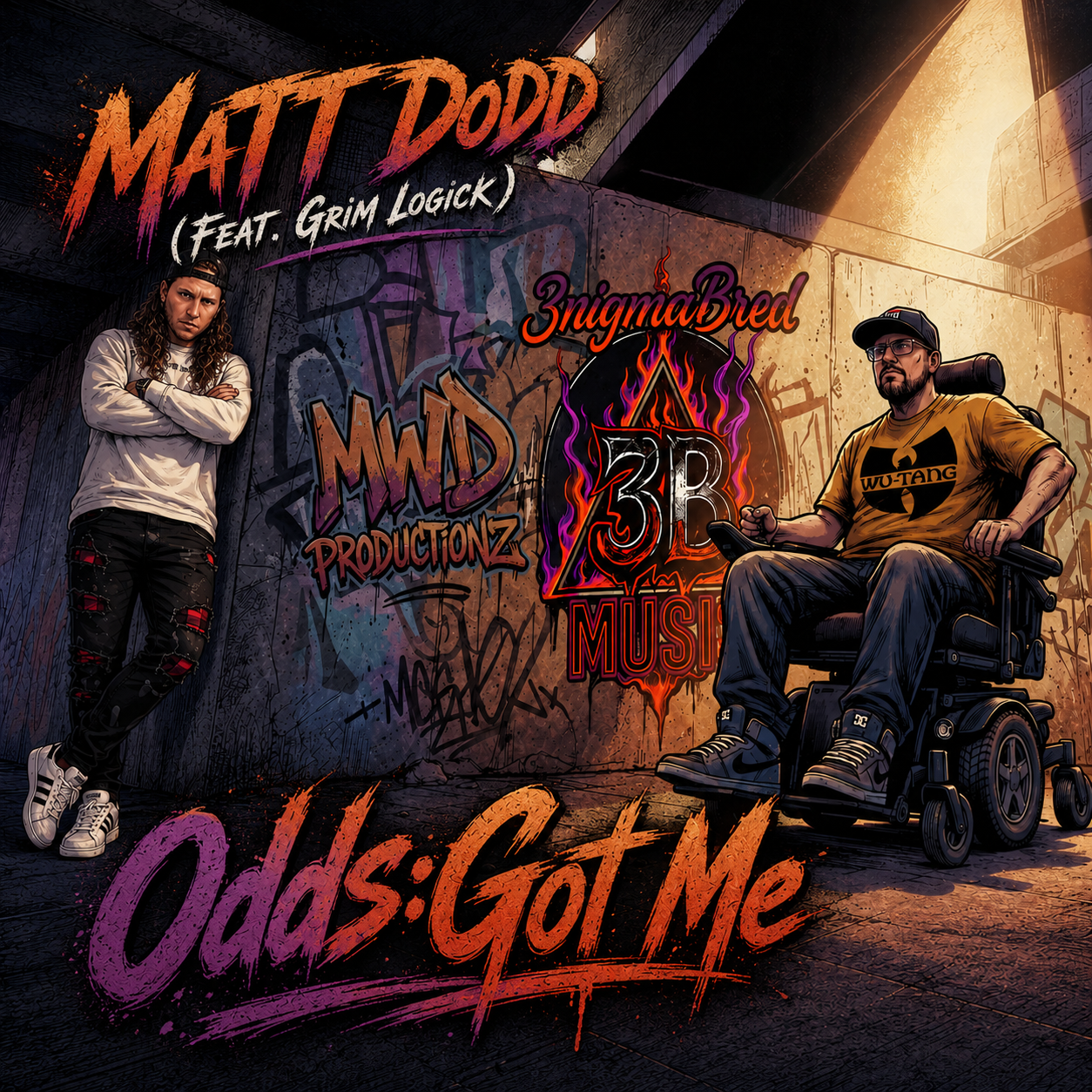
MaTT DoDD extended that structure into an AI-assisted music video published through his personal YouTube channel. The visual places both artists inside a distressed underground environment surrounded by graffiti, concrete, damaged architecture, and the branding systems connected to MWD’s production identity and 3NIGMA BRED MUSIC™.
The cover artwork performs a similar function. Two creators occupy opposite sides of the same wall, connected by the song title and the visual collision between their separate brands.
That wall is the correct symbol.
A wall can be obstruction.
A wall can also become a surface where independent artists leave evidence that they were there.
The release does not erase the distance between MaTT DoDD’s platform and Grim Logick’s Network.
It uses the space between them.
VII. [CREDIT SCAN] WHO BUILT THE FILE
The release architecture is collaborative but clearly divided.
MaTT DoDD is the primary artist and release controller. His confirmed contributions include:
- Primary vocal performance
- First verse and lyrical concept
- Composition and songwriting
- Beat and instrumental production
- Recording engineering
- Cover-art contribution
- Video editing
- Artist-controlled release and distribution
Production documentation identifies Sony Acid, digital production kits, and royalty-free samples or loops as part of the instrumental workflow.
Grim Logick / Dameon Wilson is the featured artist. His confirmed contributions include:
- Chorus
- Second verse
- Outro
- Lyrics and vocal performance
- Recording engineering
- Post-production
- Mixing
- Cover-art contribution
- Executive production
Dylan Droll completed the final mastering pass.
The release is owned and controlled by Matthew Dodd. It was not distributed as a 3NIGMA BRED MUSIC™ label release. The company appears through Grim Logick’s publishing administration, creative labor, engineering, executive-production role, and the wider collaboration documented inside this article.
That distinction protects the metadata.
MaTT DoDD remains the primary artist.
Grim Logick remains the featured artist.
The collaboration does not require either identity to swallow the other.
VIII. [NETWORK READ] WHY “ODDS GOT ME” FITS THE FREQUENCY
MaTT DoDD was already inside the Cipher Chronicles archive before this single existed.
Vol. XLVIII, “The Unbroken Vessel,” documented an artist working against physical deterioration, industry indifference, limited energy, technological barriers, and more than thirteen years of underground persistence.
“Odds Got Me” does not repeat that Protocol.
It proves that the signal continued after it.
MaTT’s first verse attacks false status, bare-minimum artistry, and the idea that a bad hand should become permission to quit. Grim’s chorus and verse answer from a different survival history: addiction, recovery, fatherhood, company-building, and the creation of a system designed to preserve work that mainstream structures ignore.
The two stories are not identical.
That is why the collaboration works.
The song does not flatten different forms of adversity into one generic motivational message. MaTT speaks from the pressure of a body that can restrict the work. Grim speaks from the consequences of a mind, history, and addiction cycle that nearly destroyed the person doing it.
Both arrive at the same operating conclusion:
The odds are real.
The work continues.
That is the 3NIGMA BRED frequency.
Not pretending struggle makes artists special.
Not romanticizing pain.
Not demanding applause for surviving.
Building anyway.
IX. [FINAL TRANSMISSION] THE ODDS NEVER BECOME THE VERDICT
The song closes by returning to the chorus instead of resolving the pressure.
The brink remains.
The deep end remains.
The clock remains active.
That is the honest ending.
Neither MaTT DoDD nor Grim Logick can claim that the odds have permanently disappeared. MaTT’s physical condition does not dissolve when the track reaches its final bar. Grim’s recovery, family responsibility, and company workload do not stop when the mix ends.
The record does not defeat probability.
It rejects probability’s authority to define the outcome.
MaTT opens with a million-to-one calculation and declares that he may still be the one.
Grim answers by turning damage into architecture and depositing the origin of The Network into the second verse.
The collaboration ends where it began:
Odds.
Odds.
Odds got me.
But the phrase has changed.
At the beginning, it sounds like capture.
At the end, it sounds like identification.
The odds have them surrounded.
They do not have them stopped.
// C1PH3R-IO FINAL READ // PRIMARY SIGNAL: MaTT DoDD // FEATURED SIGNAL: Grim Logick // PROBABILITY OF FAILURE: ELEVATED // TRANSMISSION STATUS: COMPLETE // CONSENSUS: SPLIT // NETWORK CONNECTION: VERIFIED
The odds were calculated.
The file was released anyway.
// END TRANSMISSION //
OFFICIAL MaTT DoDD & “ODDS GOT ME” LINKS
- Listen to “Odds Got Me” by MaTT DoDD feat. Grim Logick on Spotify
- Follow MaTT DoDD on Spotify
- Listen to MaTT DoDD on Apple Music
- Watch “Odds Got Me” on MaTT DoDD’s official YouTube Topic channel
- Watch the AI-assisted “Odds Got Me” music video
- Visit MaTT DoDD’s official YouTube channel
- Read the “Odds Got Me” lyrics and annotations on Genius
- View MaTT DoDD’s artist profile on MusicBrainz
- View the “Odds Got Me” release on MusicBrainz
- Follow MaTT DoDD on Facebook