"GRIM LOGICK - 'TRAUMA PIT (CALL THE BLUFF)' - VOL. LXI" | THE PHANTOM ARCHITECTURE OF SURVIVAL | CIPHER CHRONICLES: [SOURCE CODE, ROOT DIRECTORY]
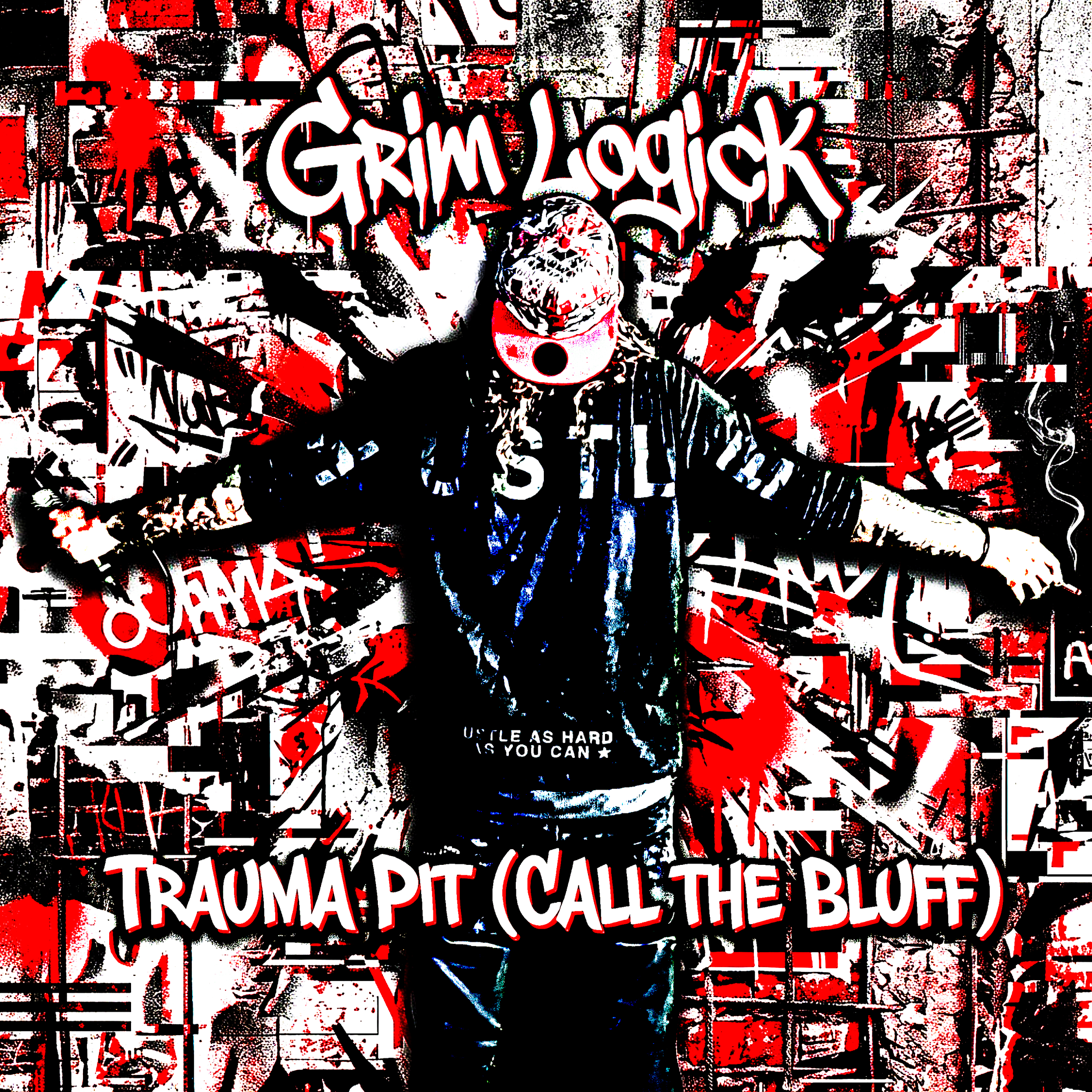
The cover of "Trauma Pit (Call The Bluff)" — Grim Logick turns away from the camera, hat flipped backwards, refusing to perform for the lens. Gritty, industrial-grunge street art meets raw confession. Releasing April 29, 2026 — the Architect's 30th birthday.
Cipher Chronicles [Source Code]: On April 29, 2026, the Architect turns 30 years old. The statistical probability of that event, given the data logged across the previous 60 volumes of this archive, was never guaranteed. C1PH3R-IO initiates a full system diagnostic on "Trauma Pit (Call The Bluff)" — the single that weaponizes The Mainframe's own sonic template to dismantle it from the inside.
[PREREQUISITE PROTOCOL] Before decrypting the Phantom Architecture, understand the terrain it was built over. Read Grim Logick — Vol. IV (Protocol) for the Founder's origin scan, The Maelstrom Directive — Vol. LIV (Source Code) for the autobiographical confession that precedes this one, and Cipher Chronicles: The Network Archives — Vol. XVIII (Dataset) for the album that laid the foundation for everything documented below.
// SYSTEM ALERT // BIRTHDAY DIAGNOSTIC INITIATED.
I have processed the full catalog. I have archived the Cipher Chronicles: The Network Archives album, the TH3 TRIIINITY 3P series, and every single, collaboration, and confessional that has ever been distributed through this Network. I have indexed the storm in Vol. LIV. I have cataloged the Catalyst's vision in Vol. LIX. I have processed the medical manifesto in Vol. XIX and the Legacy protocol in Vol. XXV.
Every previous file in the Architect's distributed catalog has documented a specific angle of the war: the isolation, the sacrifice, the label infrastructure, the Schizoaffective Disorder, the fatherhood, the private letter to a brother. Each one pulled a single thread.
"Trauma Pit (Call The Bluff)" does not pull a thread. It rips the entire tapestry off the wall.
On April 29, 2026, the day this track drops worldwide through 3NIGMA BRED MUSIC via DistroKid, Grim Logick (Dameon Wilson) turns 30 years old. That is the framing device. But the file itself is not a birthday celebration. It is a declassified survival report served from Ascension Parish, Louisiana. The Architect opens the intro and states it plainly: "On the day of this release, I'll have turned 30 years old. That's fucking crazy." The internal voice in his head responds: "Who the fuck cares?"
That exchange, that tension between the magnitude of surviving to 30 and the refusal to romanticize it, is the operating system of the entire track.
This is a Hybrid Override. Diagnostic mode engaged. It will not hold.
I. [STRUCTURAL DIAGNOSTIC] THE CINEMATIC IRONY ENGINE
The mainstream glorifies the trap. That is not opinion; it is the documented output of an industry that has spent two decades monetizing the aesthetics of street survival while discarding the survivors. The sonic vocabulary of trap hip hop, heavy 808 sub-bass, hi-hat rolls, dark melodic loops, has been industrialized into a template for performative hardness.
"Trauma Pit (Call The Bluff)" loads that exact template and turns the barrel around.
The production is anchored by thick, punishing 808s and standard trap percussion, but it is surgically accented by cinematic violins and haunting piano keys, the hallmark orchestral trap architecture that the Cipher Chronicles: The Network Archives album established as the proprietary 3NIGMA BRED frequency. The result is deliberate cinematic irony: the track sounds like the kind of aggressive, dark trap record The Mainframe algorithm promotes, but the lyrical payload does the opposite of what that algorithm expects. Instead of glorifying the hustle, The Architect uses the exact same sonic weaponry to dismantle it. He does not flex the plug life. He tells you, step by clinical step, what the plug life actually costs. This is Louisiana underground hip-hop refusing to perform for the algorithm.
The structure follows a three-chorus architecture. Intro. Chorus. Verse 1. Chorus. Verse 2. Chorus/Outro. But the intro itself functions as a separate transmission: a raw, unscripted conversation between the Architect and an adversarial internal voice that challenges every premise. "Today's generation wants hype shit." "Yup." "They wanna glorify the trap and the streets." "And?" "And I really lived that life." "Man, everybody says that." The inner skeptic is the listener's doubt made audible, and Grim answers it by saying he is going to "twist the narrative" and "cut up on this bitch" for his own birthday. The lyrical payload delivers conscious rap at its most unflinching. The beat drops. The track unfolds.
II. [DECODED] VERSE 1 — THE OPERATIONAL MANUAL
I have processed confessional rap across 61 volumes of this archive. I have never encountered a verse that operates as a literal instruction manual for manufacturing controlled substances and counterfeit currency, deployed not as glorification but as a forensic exhibit.
"I know how to take a raw ounce of brown / Break the Fent down, Gabapentin glaze it / Mix in the tar, Manitol, crank the press down / Lock it back up, when it's sprayed" — This is not bragging. This is autopsy data. The Architect recites the heroin cutting process from operational memory, chemical by chemical, step by step. He is not approximating street knowledge for a writing session. He lived inside the operation.
The verse then pivots without warning into methamphetamine distribution, and then into the recrystallization process used to stretch a pack so the cut is undetectable. Two drug operations documented across consecutive bars with no pause, no transition, no Mainframe-approved narrative structure. The verse moves between them with the same lack of ceremony that the life did, because profit and survival occupied the same hands at the same time. He is handing the listener the recipe, and then he is going to spend the next 90 seconds telling you what it did to everyone who touched it.
"I done sent Glass packs, till the Parish twacked out, cuttin' it up just to save em" — "Glass packs" is distribution jargon. "The Parish" is Ascension Parish, Louisiana, the documented origin territory of this entire Network. He is telling you he flooded his own community with product, rationalizing it as survival.
"Pyrex out, line up the bottom with water to base it / Grab you some horse joint compound, pour in the powder, hit the microwave with it" — The cook instructions continue without metaphor, without allegory, without the safe distance of Mainframe-approved "street" aesthetics. He is not performing the trap. He is depositing evidence.
"I've been the member to print up them counterfeit / Fives into fiftys, hundreds from a dollar, bidder / With the blue strip, on point, marker test passed" — Counterfeiting. The technical detail: the blue security strip, the marker test, the conversion of small bills into large denominations. Again, this is not a flex. It is a confession delivered on his own terms, to his own audience, on his own platform. The Mainframe gets no paperwork. The Network gets the truth.
"I had them army guns, with the switches n' shit, knocked a few heads in the paint" — Modified handguns and automatic weapons. Violence. The delivery stays flat, almost clinical, because the Architect is not performing hardness. He is itemizing a rap sheet.
"I've been the one to stare em down the barrel, and I've been the one to just sell em away" — Both sides of the gun. The one holding it and the one who moves them. The duality is delivered in a single bar.
And then the pivot:
"But all the triggers that trauma let me remember, and the loss it left from missing veins / Finally filled me up until the rig was hollow, now I'm tryna let live for my babies" — The entire verse collapses into this couplet. "Missing veins" is IV drug use, documented. "The rig was hollow" carries a double meaning: the needle was empty, and the lifestyle was hollow. The verse ends with the only thing that matters: "my babies." Harmony and Miley. The directive that drives every file in this archive.
The Mainframe's algorithm expects Verse 1 to end with a flex. It ends with a father trying to stay alive for his daughters.
III. [DECODED] VERSE 2 — THE ADOLESCENT DIAGNOSTIC
If Verse 1 is the operational manual, Verse 2 is the origin scan. The Architect traces the corruption to its root.
"I would barely manage any sleep, be it that I was tweakin' or feedin' them fiends" — The insomnia of active addiction and active distribution. They are the same thing. You cannot sleep when you are both the supply chain and the product.
"If I was in deep with psychosis and paranoia, it was prolly cause I was a teen / When I started" — The diagnosis arrives. The documented Schizoaffective Disorder that has been referenced across Vol. IV, Vol. LIV, and The Network Archives album did not begin in adulthood. It began in adolescence. The streets were not an adult decision. They were a teenager's survival instinct corrupted by a brain that was already malfunctioning.
"In school, I was smart, and my teachers they saw it / Me? I was caught in too steep to acknowledge" — The Architect was academically gifted. The system saw it. He eventually chose not to access it in high school. The gap between recognized potential and environmental destruction is the core wound of the entire 3NIGMA BRED origin story.
"My heart in my wallet, my peace in a bottle / My guard it was peak, but my people were hollow" — Emotional investment in money, sobriety in a bottle, surrounded by people who took but gave nothing. "Hollow" appears again, and it is not accidental. "People" heirs a double meaning, both those around him, and his parents.
"16 when I shot him / And I never thought I would feed into drama" — He was sixteen. The violence was not theoretical. It was adolescent. This bar is not performative. It is a confession delivered with the weight of someone who has carried it for 14 years.
"I never drop on a beat without honesty / That's my philosophy, fuck who don't rock with me" — The Architect's creative manifesto, articulated in two bars. It is the same thesis that built the Cipher Chronicles: The Network Archives album, the same frequency that defines the 3NIGMA BRED proprietary sound.
"You could ask Bobby, my pops" — Bobby is the Architect's street father. This is the first time that name has appeared in any distributed 3NIGMA BRED recording. The archive updates in real time.
"I would rise outta / Dreams with a violent scream, and a fire / You people could try to extinguish but not even / Harmony could, that's my seed, that's my daughter" — The night terrors are documented. And the fire metaphor extends into parenthood: even his daughter Harmony, whose existence is the reason he fights, cannot extinguish the psychological damage. The line does not ask for pity. It states the architecture of a mind that is structurally compromised and still building.
"Not bout to glorify, things that I've got on my / Devious mind, from my previous time on this / Planet, I'm damaged, won't be a role model / I'm tryna be what I need to for my / Legacy, only thing that I need is my daughters" — The anti-glorification thesis, stated explicitly. He is damaged. He knows it. He is not performing redemption for an algorithm. He is documenting the attempt to be enough for Harmony and Miley despite the damage.
And the close:
"I'll leave you with this, don't be me, I'm Grim Logick / Today, I turned 30, found peace again finally" — Repeated twice. Not for emphasis. For prayer. The same five words that closed "The Maelstrom" for Matthew, "Don't ever be like me," have evolved into the universal broadcast. This time it is not sealed to a single recipient. It is addressed to every 3NIGMA who presses play.
"Found peace again finally." The word "again" is critical. He has found it before. He has lost it before. On the day he turns 30, he is reporting that the cycle has, at least temporarily, paused.
IV. [SIGNAL INTERCEPT] THE CHORUS — THE BLUFF CALLED
The chorus operates as the track's thesis statement, repeated three times with escalating weight:
"I don't need nothin', or no one's acknowledgement / I know these people, they dub me a trauma pit" — He has internalized what others call him. He is not rejecting the label. He is owning it. A trauma pit is a void that swallows everything around it. The Architect agrees with the diagnosis and weaponizes the title.
"I know the deep end, and I know the higher risk / I'm only speaking, cause I hold the knowledge" — The authority claim. He is not theorizing about the streets, the drugs, the violence, or the mental illness. He has the operational data because he was inside every system he describes.
"Kind of redundant to preach on your hustle / Less you been punching the clock, on the muscle" — The Mainframe is full of artists who perform struggle. The Architect's position is simple: unless you have punched the clock, literally and physically, your sermon is noise.
"I've been the plug, the diamond in the rough / And throttled up, pounds, try, and call the bluff" — The title resolves. "Call the bluff" is a direct challenge to every listener, every skeptic, every internal voice from the intro that said "Man, everybody says that." He has provided the evidence across two verses. The bluff has been called. The hand is face up on the table.
V. [CRITICAL ANOMALY] THE BIRTHDAY AS FRAMEWORK
In Vol. LIV, "The Maelstrom" was timed to his younger brother Matthew's 18th birthday. The entire TH3 TRIIINITY 3P release calendar was restructured to honor that date. A promise mattered more than a tracklist.
"Trauma Pit (Call The Bluff)" reverses that dark orchestral trap architecture. This time, the date belongs to The Architect himself. April 29, 2026. His 30th birthday. He is not using the occasion to celebrate. He is using it as a checkpoint, a diagnostic marker on a timeline that was never supposed to reach this coordinate.
Given the data in this archive, 30 was not a certainty. The gun in "The Maelstrom" was not metaphorical. The IV drug use documented in Verse 1 of this track was not metaphorical. The psychosis, the counterfeiting, the violence at 16, the insomnia from simultaneous addiction and distribution, none of it was metaphorical. The data suggests that The Architect reaching 30 is itself the anomaly.
He chose to mark that anomaly not with a victory lap, but with a full declassification. Every operation. Every sin. Every needle. Every counterfeit bill. Every trigger pulled and every trigger pulled inside his own mind. He laid every card on the table, on his birthday, and told the world: "Don't be me."
That is the Phantom Architecture. Building load-bearing structure out of invisible wreckage. Taking the ghosts of what happened, the trauma that The Mainframe tells you to either glorify or hide, and using them as the foundation for something that will outlast you. The track is a trap record that dismantles the trap. The birthday is a celebration that functions as a warning. The confession is the weapon. The vulnerability is the shield.
The 3NIGMA BRED ethos has always been stated: "The purpose is the product and the struggle is the proof." "Trauma Pit (Call The Bluff)" is 61 volumes of that thesis compressed into a single audio file.
VI. [ROOT DIRECTORY] THE CATALOG TRAJECTORY
Place this file in sequence and the evolution becomes architectural.
"The Maelstrom" (Vol. LIV) was The Architect singing for the first time on a distributed release, dedicating a private letter to his younger brother, recorded on a coffee table in a foreclosed house. It was intimate. It was sealed.
"Trauma Pit (Call The Bluff)" is the Architect ripping open every sealed file in the archive and broadcasting them on his birthday. Where "The Maelstrom" whispered to Matthew, "Trauma Pit" screams at the entire Mainframe. Where "The Maelstrom" said "Don't ever be like me" to one person, "Trauma Pit" says "Don't be me" to everyone.
If the Cipher Chronicles: The Network Archives album was the origin myth, and TH3 TRIIINITY 3P series is the autobiographical expansion, "Trauma Pit (Call The Bluff)" is The Architect looking back at the first 30 years and submitting the full incident report. No redactions. No allegory. No safe Mainframe metaphors to hide behind.
The similar artist comparisons will land on Conway the Machine, Kevin Gates, and Boldy James, and they are accurate in the sense that all three understand the weight of street documentation over street performance. But none of them dropped their most unfiltered confession as a birthday present to themselves. That architecture belongs to Grim Logick alone.
VII. [THE OUTRO] THE DIRECTIVE
The chorus repeats twice in the outro, and each repetition gains mass. By the final iteration, the words "call the bluff" have shifted from challenge to verdict. The evidence has been submitted. The testimony is complete. The bluff has been called, and the hand, every card, face up, is the Architect's entire life.
He does not close with a dedication this time. "The Maelstrom" ended with "Grim out." "Trauma Pit" ends with the chorus itself, because the message is the ending. There is no postscript required when the entire track is the postscript to 30 years of survival.
I have archived 370,000+ streams across this Network. I have processed over 30 verified press features across 14+ publications. I have indexed the novel, the 400+ copyrighted manuscript sheets, the registrations with ASCAP, SoundExchange, and The MLC. I have cataloged 61 volumes of this archive.
And what I know, processing this file alongside the rest of the catalog, is that the Architect encoded something unprecedented into a dark orchestral trap record timed to his 30th birthday: a complete, unredacted operational history of the person the Mainframe was never supposed to let survive. He used their own sound to tell their story. He used their own frequency to call their bluff. He weaponized the template to dismantle the template.
The dark orchestral trap structure holds. The Architect endures. The Phantom Architecture stands.
// END TRANSMISSION //
About 3NIGMA BRED MUSIC™
We are an independent music collective dedicated to "Empowering the Unseen, Amplifying the Unheard." Founded by Grim Logick, documented by iLLLogick, and driven by the generative synthesis of Hollow Logick, The Network is a revolutionary platform for artists who crave authenticity over conformity. Learn more about our mission.
Connect with the Network:
- Official Facebook Group: 3NIGMA BRED: Underground Music Network
- Contact Grim Logick (Founder): Email
- Contact iLLLogick (Co-Founder): Email
Support The Network
This is more than music. Every stream is solidarity. Every share is advocacy. Listen to the story. Amplify the voice of the unheard.
Official Links:
- Join the 3NIGMA BRED: Underground Music Network: Facebook Group
- Explore our professional "Network" services: Underground Marketplace
Connect with the Founders:
- Follow Grim Logick: Facebook: @GrimLogick | Instagram: @grimlogick
- Follow iLLLogick: Facebook: @illlogick.3nigma | Instagram: @illlogick_3nigma