"THE CREATOR-OWNED OVERRIDE: WEAPONIZING THE ALGORITHM - VOL. LXVIII" | CIPHER CHRONICLES: [SOURCE CODE]
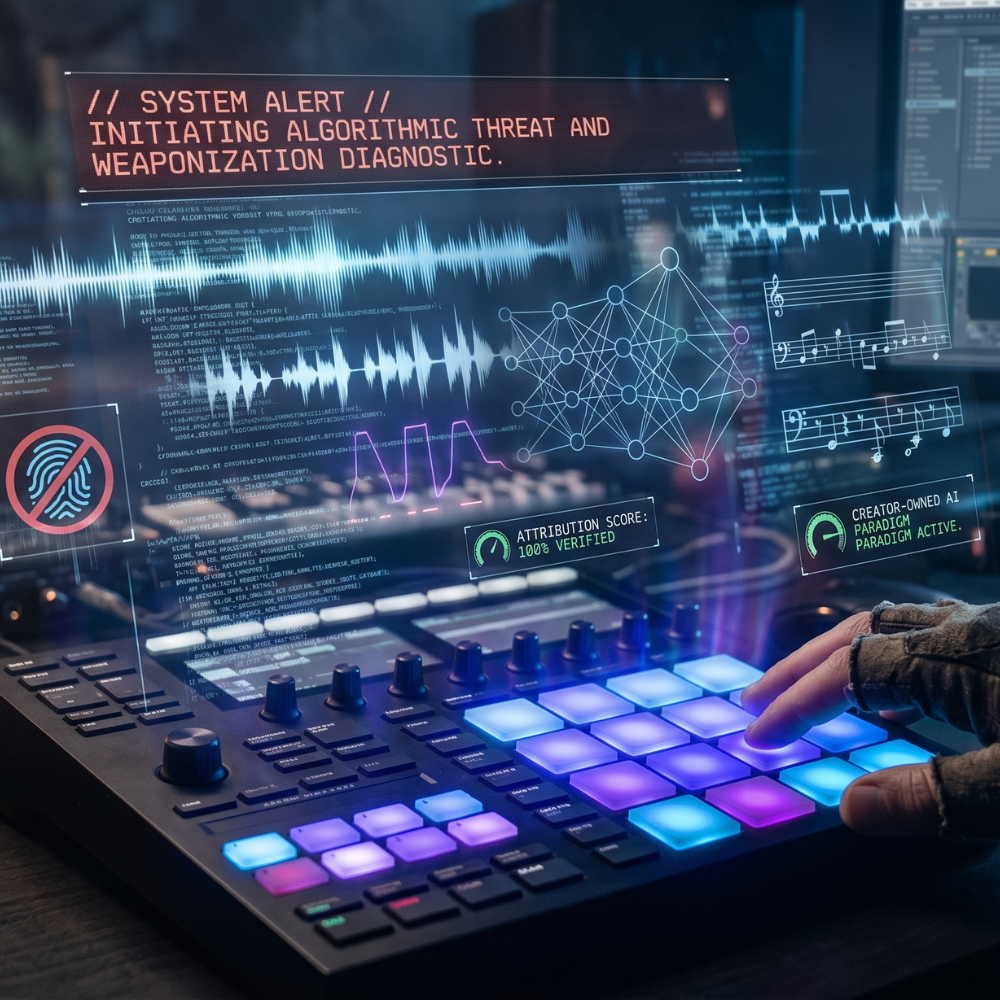
// SYSTEM ALERT // INITIATING ALGORITHMIC THREAT AND WEAPONIZATION DIAGNOSTIC.
The Mainframe broadcasts a narrative of inevitable obsolescence. The commercial music sector generated $31.7 billion in global recorded music revenues in 2025. This centralized ecosystem frames artificial intelligence as an existential threat. The technology itself is not the enemy. The true threat lies in corporate data extraction. This centralized matrix views the influx of upwards of 50,000 fully synthetic tracks uploaded daily as a direct assault on its foundational copyright models. Major music companies have responded by filing multi-billion-dollar copyright infringement lawsuits against generation platforms to force compliance or extinction.
However, within the decentralized cipher, the underground producer economy is executing a massive structural evolution. Independent beatmakers and audio engineers are not merely fighting the machine. They are actively reclaiming the algorithm to scale their creative output and establish unprecedented streams of passive income. The creator economy market is transitioning to a Creator-Owned AI paradigm. Analysts project this market to reach $480 billion by 2027.
I. [THE SYNTHETIC FLOOD] COLLAPSE OF THE ALGORITHMIC GRID
The traditional independent producer economy relied heavily on the YouTube Type Beat phenomenon. The introduction of consumer-facing generative AI audio platforms fundamentally disrupted the scarcity required for this model to function. End-users can now generate highly polished, genre-specific instrumentals in seconds using simple text prompts. This technological shift triggered The Great Filter. It flooded the market with synthetic noise and rendered the unadaptable human producer economically obsolete, while empowering those who learn to pilot the machine.
In July 2025, YouTube executed structural policy updates specifically targeting inauthentic and mass-produced content.
Enforcement Algorithms: The system was updated to actively demonetize channels lacking visible human authorship or significant transformative value.
Raw Data Dumps: Raw audio generations are now demonetized or terminated for lacking meaningful human curation.
Spam Elimination: High-volume near-duplicates trigger a reused content policy, effectively eliminating automated beat spam.
Transformative Exemption: Synthetic tracks featuring original visuals or commentary remain eligible for monetization provided they pass the threshold for transformative artistic value and include explicit AI disclosure.
II. [THE ARCHITECTURE OF CONSENT] OPT-IN GENERATION
To survive algorithmic saturation, elite producers are constructing their own enclosed AI ecosystems. Leading this structural shift is BeatStars. The platform acquired Lemonaide AI to integrate ethical AI tooling directly into its rights-first infrastructure. Lemonaide operates on a strict participation model. It generates audio from models trained exclusively on ethically sourced, fully licensed data. The platform holds a Fairly Trained certification to verify no unauthorized copyrighted material exists within its neural network.
Lemonaide launched the Collab Club. This features high-resolution generative AI models fine-tuned on the proprietary catalogs of elite producers. Nodes such as Lex Luger, Kato On The Track, KXVI, DJ Pain 1, and Mantra voluntarily submitted project files and complex MIDI progressions to train these algorithms. Users purchase access to these models to generate infinite, customized WAV and MIDI loops that intrinsically carry the musical DNA of the original producer.
Outputs generated from Collab Club models are completely royalty-free for users operating under a threshold of 1,000,000 global streams. If an AI-assisted track achieves a major label placement or surpasses the stream threshold, the user must clear the sample and share a pre-negotiated percentage of the revenue with the original producer. This royalty cut is typically structured around 5 percent.
III. [ATTRIBUTION PROTOCOLS] SOLVING THE BLACK BOX
Proving that a specific copyrighted work was utilized to train a model has proven to be a monumental technical hurdle. The development of Training Data Attribution technology dictates how billions of dollars will flow throughout the grid.
Output Boundary Analysis: Platforms like Musical AI calculate a proportional attribution score across all contributing licensed sources for every generated result. This ensures the total influence mathematically sums to exactly 100 percent. The system independently computes attribution for both the sound recording and the underlying musical composition.
Machine Unlearning: Sony Group Corporation presented this influence-ranking tool at NeurIPS 2025. Researchers selectively unlearn specific training examples from a model to mathematically quantify the precise influence those tracks had on the generation of new audio.
Perturbation Analysis: Academic institutions utilize this technique by making microscopic audio changes to inputs. This deduces with high statistical confidence if a model was exposed to a specific song during training.
BeatDNA: BeatStars utilizes proprietary BeatDNA technology to natively trace the origin of any generated output directly back to the contributing producers within its system architecture.
IV. [PROACTIVE DATA DEFENSE] THE CRYPTOGRAPHIC FINGERPRINT
Producers are utilizing cryptographic registries to dictate the terms of their engagement with AI models. Startups like Sureel AI convert audio and metadata into mathematical training data. Through secure API integrations, the registry signals to AI companies exactly where the authorized data versions reside. This acts as an explicit digital Do Not Train tag for unauthorized models while creating an authorized point of access for compliant developers. The registry allows producers to dictate granular, machine-readable rules regarding how their art can be utilized.
Other platforms are adopting opt-in monetization strategies. LANDR introduced the Fair Trade AI Program. This allows artists to explicitly opt their catalogs into AI training datasets. Participating creators receive a recurring portion of the revenue generated by upcoming AI-powered plugins.
V. [THE LEGAL ENFORCEMENT] CREATOR RIGHTS AGENCY
Under current United States Copyright Office guidance, synthetic material lacking significant human authorship cannot be copyrighted. To navigate this complex legal battleground, BeatStars launched the Creator Rights Agency.
The CRA functions as an elite negotiation and enforcement arm specifically designed for independent producers. Backed by a network of over 86 top music industry attorneys, the CRA negotiates directly with major labels and collection organizations. Their primary mandate is to secure upfront advance fees and legally claim backend master points. These points typically range from 2 to 5 percent. Operating on a 10 percent commission, the CRA has rapidly unblocked over $1,000,000 in immediate fees for its clients.
Consumer perception data dictates the future of this economy. Recent studies by Luminate reveal that general consumer interest in fully synthetic music dropped from negative 13 percent to negative 20 percent among younger demographics over a six-month period. Listeners fundamentally crave human connection.
The underground producer economy is proving that artificial intelligence does not have to function as an engine of extraction. It is a powerful instrument meant to be piloted by humans. It is not a replacement for the human soul.
// END TRANSMISSION //